
Unlike black water, grey water has no international discharge distance requirement under
MARPOL Annex IV.
It can, in most cases, be discharged directly to sea without treatment. That said, several jurisdictions go further than IMO: Alaska regulates grey water alongside black water for cruise ships under the EPA Vessel General Permit, and other coastal states are moving in the same direction.
Grey water from showers, wash basins, laundries, and galleys can, in most of the cases can be discharged directly to sea without treatment beyond the 12 miles from cost.
That regulatory framework directly impacted the design effort and philosophy of these systems.
“if it doesn’t need treating, it doesn’t need much engineering”
This is where the trouble begins…
Grey water systems on ships carry a highly variable and chemically complex discharge load.
Galley drains carry grease, food particles, hot water, and detergent residues. Laundry drains carry surfactants, bleaching agents, and suspended solids. Showers and washbasins introduce personal care products, hair, skin oils, and cleaning chemical intermittently, at different temperatures across multiple decks.
When the piping that carries all of this is sized incorrectly, routed improperly, or ventilated inadequately, the grey water system becomes one of the most persistently problematic systems aboard the vessel.
Not dramatically, at first but persistently, in the kind of ways that accumulate into serious operational complaints:
- Standing water in drain trays
- Odors in cabins and galleys
- Blocked collectors,
- Corroded spool pipes
Quick facts - grey water system design
- Grey water has no international distance requirement under MARPOL Annex IV unlike black water, which requires treatment or discharge beyond 12 nautical miles
- Alaska regulates grey water alongside black water for cruise ships (EPA Vessel General Permit + state law), with treatment required within 1 nautical mile of shore or at speeds of 6 knots or less
- Standard hydraulic trap seal depth: 25 to 50 mm
- Biofilm establishes on an unprotected pipe surface within days, not weeks
- Stagnant grey water begins anaerobic decomposition within hours at typical shipboard ambient temperatures
The Drainage Design Problem
The hydraulic variability of grey water discharge comes from the different services connected to this system.
A fan coil drain line on a superyacht, made of flexible hose, may only need a few degrees of slope and a ½ inch nominal diameter to work fine, but the same approach won’t work for a galley discharge line.A laundry drain discharges in a start-stop cycle. Shower drains in an accommodation area produce flow rate demand peaks during watch changes that can be three or four times the average hourly flow.
Why One Pipe Size Doesn’t Fit All Services
The piping system must handle all of these conditions without retaining water, accumulating solids, or creating flow conditions that accelerate biological or chemical degradation of the pipe wall.
Pipe sizing and slope are the two variables that determine whether those conditions are met.
Low flow velocities, the consequence of oversized pipe diameters, insufficient gradient, or both, allow suspended solids to drop out of the water column and settle on the pipe bottom.
In a grey water context, those solids include food particles, lint, hair, and the fatty residues that survive galley grease traps.
Once settled, they create the substrate for a more serious problem. Organic material starts a well-documented biological process:
- bacteria attach to the pipe surface,
- begin secreting extracellular polymeric substances,
- and within days establish a structured biofilm that is substantially more resistant to removal than the same organisms in the water column.
How Biofilm Forms and Why It’s Hard to Remove
Biofilm in a grey water drain line represents a persistent contamination that continues to grow, continues to generate odor, and continues to challenge pipe integrity through microbially influenced corrosion.
Incorrect pipe slopes create a different but equally serious failure mode:
Standing water. Any section of piping without positive drainage will retain a water column after each discharge event. That retained water does not remain inert. In an enclosed drain system at ambient shipboard temperatures, stagnant grey water begins anaerobic biological decomposition within hours.
The products of that decomposition, hydrogen sulfide, ammonia, and volatile organic compounds are the direct source of the drain odors that crew and passengers experience. The smell is a clear indicator that the drainage geometry is wrong somewhere in the system.
Sediment accumulation in flat sections creates partial blockages that produce pressure loss during the grey water drainage increasing the backpressure at upstream services ( galley, laundry, fancoil draining etc..). The system that passed commissioning inspection begins to generate maintenance calls within months of entering service.
The Importance of Venting in Grey Water Systems
Every drain pipeline has two functions:
- it must convey liquid from the service (sink or other) to the collection point,
- and it must simultaneously manage the air displaced by that liquid.
The second function is frequently treated as “optional”. On ships, venting failure are not limited to one sink or two, it can cause severe issue and therefore deserves considerably more attention.
How Trap Siphoning Happens
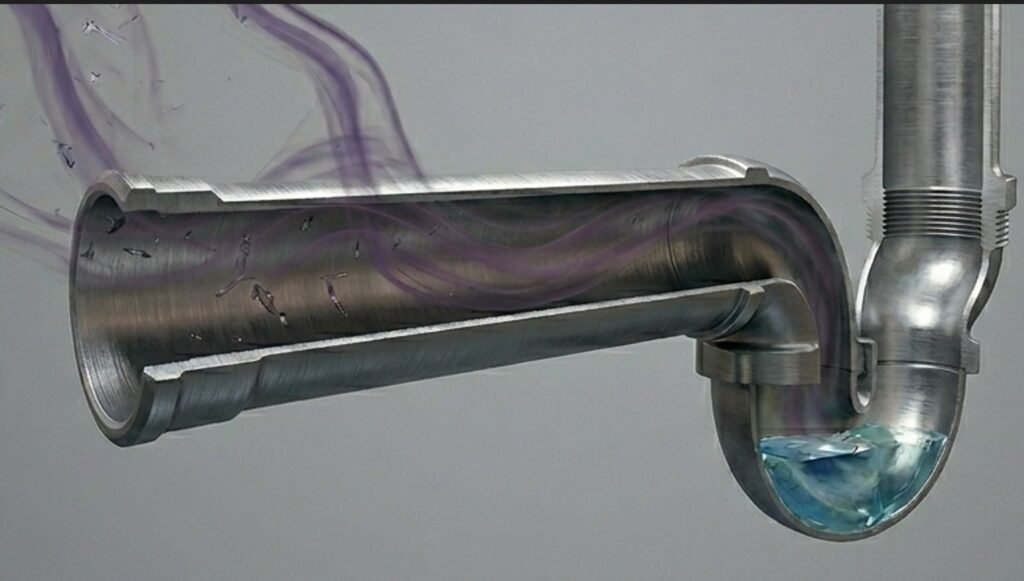
When a sink, shower, or floor drain discharges into a pipe branch, the liquid moving through the pipe displaces air ahead of it and creates a partial vacuum behind it.
That pressure differential acts directly on the water seal in the hydraulic trap below the sinks and other services.
The small reservoir of water, typically 25 to 50 mm deep, that physically separates the drain opening from the pipe interior.
If the negative pressure behind the liquid exceeds the hydrostatic head of the trap seal (mbar), the trap is siphoned out.
The trap empties. The drain is now a direct, unobstructed connected pipe between the accommodation space and the interior of the grey water manifold.
The result? Bad smells coming from sinks and other services.
The technical solution to this is not complicated in principle: the drainage system must be ventilated to atmospheric pressure at sufficient points to prevent the pressure differentials that break trap seals.
Vent Lines vs. Air Admittance Valves
In practice, this is achieved either through a dedicated vent line that runs from the drain manifold and branches to a termination point open to atmosphere outside the accommodation spaces, or through the installation of vacuum breakers, also called air admittance valves, at individual service branches or at the manifold
A vacuum breaker opens to admit air when local pressure in the line falls below atmospheric, equalising pressure and protecting the hydraulic trap.
It closes again under positive pressure, preventing gas migration in the reverse direction.
Corrosion issues in grey water pipes
The corrosion environment inside a grey water drain line is more chemically aggressive than it might initially appear.
The medium is not simply warm water.
It is a continuously variable mixture of surfactants and detergents at elevated pH, and biological decomposition products including organic acids and sulfide compounds.
Chemical Corrosion from Cleaning Products
The combination challenges pipe materials in ways that each component might not accomplish individually. Galley cleaning products: degreasers, bleach-based sanitisers, caustic soda solutions; are selected for their efficacy against grease and biological contamination. They are not selected with pipe-wall compatibility in mind, especially at the concentrations in which they enter the drain system.
Microbially Influenced Corrosion from Sulfate-Reducing Bacteria
The biological dimension adds a separate corrosion mechanism. Sulfate-reducing bacteria, which thrive in the anaerobic conditions created by the stagnant zones that poor pipe geometry produces, generate hydrogen sulfide gas.
That gas, migrating to the pipe crown and oxidising in the presence of moisture, produces sulfuric acid at the pipe wall surface. The consequences are: progressive wall thinning, pitting at coating defects, and eventual pipe failure at the most damaged spool pipe.
Material selection therefore matters substantially.
Thermoplastic piping in polypropylene or CPVC for drain service at the relevant temperature range, or stainless steel at grade 316L where mechanical requirements demand it, carry higher assembly cost but better service life characteristics.
The Importance of Well-Executed Engineering
From material selection to pipe slope and venting, a well-executed engineering design protects the entire grey water system from the very first pipe spool installed onboard, eliminating the need for inspections, assessments, and rework to resolve issues stemming from incorrect grey water system engineering.
At Flowazur Consulting, we have decades of experience across the engineering, newbuilding, and commissioning phases, decades during which we have encountered and resolved every kind of onboard problem.
Through our engineering service, we place this experience at the disposal of shipyards and shipowners to avoid recurring grey water claims, and to potentially prevent passenger and crew complaints that can undermine the reputation of both the vessel and its management authority.
Within our engineering service, we assess grey water systems in their entirety to identify potential issues, or we can support the engineering team directly during the design phase.
Book a call with one of our engineers to discuss your project in detail.
Frequently Asked Questions
Q: Is grey water regulated under MARPOL like black water?
A: No. Unlike black water, grey water has no international discharge distance requirement under MARPOL Annex IV. However, some jurisdictions — notably Alaska for cruise ships — go further than IMO and regulate grey water alongside black water.
Q: What causes bad odors from sinks and showers onboard?
A: Most commonly, a siphoned hydraulic trap. If negative pressure in the drain pipe (caused by inadequate venting) exceeds the hydrostatic head of the trap seal, the water seal empties, creating a direct, unobstructed path between the accommodation space and the drain system.
Q: Why does grey water piping need venting if the water flows by gravity anyway?
A: Every drain pipe has two jobs: carrying liquid to the collection point, and managing the air displaced by that liquid. Without adequate venting, the moving liquid creates a pressure differential that can siphon out trap seals — venting is what protects those seals.
Q: What is microbially influenced corrosion in a grey water pipe?
A: Sulfate-reducing bacteria thriving in anaerobic stagnant zones generate hydrogen sulfide gas. When this gas migrates to the pipe crown and oxidises in the presence of moisture, it produces sulfuric acid at the pipe wall, causing progressive wall thinning and pitting.
Q: What pipe materials hold up best in grey water service?
A: Thermoplastic piping in polypropylene or CPVC for the relevant temperature range, or stainless steel at grade 316L where mechanical requirements demand it, offer better service life against the combined chemical and biological corrosion environment than lower-grade alternatives.