
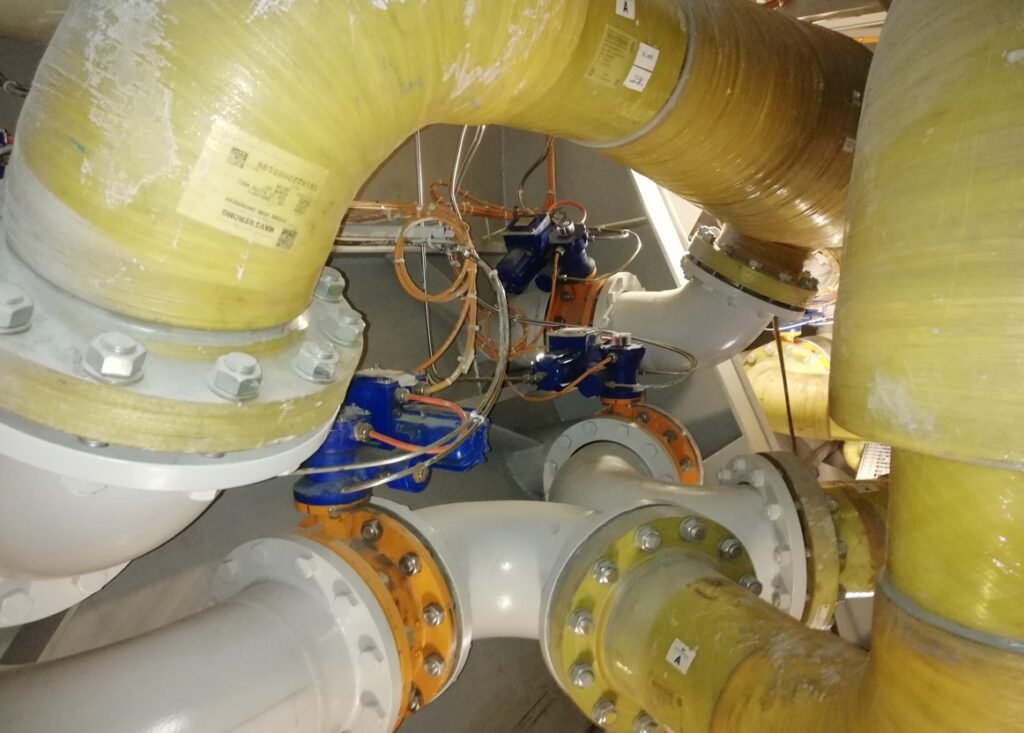
Since 1 January 2020, every vessel in international trade has been required to comply with the 0.5% global sulphur (SOx) cap under the reviewed MARPOL Annex VI, with a tighter 0.1% limit in designated Emission Control Areas (ECAs). The most widely adopted alternative compliance pathway, fitting an exhaust gas cleaning system, commonly called “scrubber”, allowed shipowenrs to continue running on cheaper high sulphur fuel oil while meeting the SOx emissions standard through onboard treatment.
The result was one of the largest and most compressed retrofit campaigns the commercial fleet has seen: by the mid-2020s, over five thousand scrubber systems had been installed across the global fleet.
The maintenance data is now arriving, and it tells a consistent story.
Gard, one of the marine insurance market’s largest P&I clubs, has published a review of scrubber-related claims drawn from six years of hull and machinery experience.
Approximately 60 percent of all scrubber-related claims originate from corrosion and leakage in the overboard discharge piping, in some cases leading to engine room flooding.
The scrubber tower itself, the type-approved system component, is rarely where the issues occurs. The failure occurs in the piping that connects it to the sea.
Equipment performing within its specification while the surrounding pipe system fails.
The main reason behind it it always the same: the integration engineering was inadequate, the piping was designed without sufficient analysis of the actual service conditions, and the commissioning process was never capable of detecting what was wrong.
Quick facts : scrubber system piping failures
- ~60% of all scrubber-related P&I claims originate from corrosion/leakage in the overboard discharge piping (over 70% by replace-cost) Gard, 6-year claims review
- Washwater pH at overboard discharge must not be less than 6.5 under IMO’s 2015 EGCS – Guidelines (Resolution MEPC.259(68))
- Over 5,000 scrubber systems installed across the global fleet by the mid-2020s
- Global sulphur cap: 0.5%, tightened to 0.1% inside Emission Control Areas (ECAs)
- Documented case: the same design error caused two separate overboard pipe failures on.
The Service Environment That Piping Designers Underestimate
To understand why scrubber piping fails at the rate it does, it is necessary to understand what is actually flowing through it.
In a wet exhaust gas cleaning system, whether open-loop, closed-loop, or hybrid , the scrubbing action occurs when seawater or alkaline freshwater is brought into contact with the exhaust gas stream, absorbing sulphur dioxide and converting it to sulphurous and sulphuric acid in solution.
What’s Actually Flowing Through the Pipe
The washwater that exits the scrubbing tower is an acidic, particle-laden liquid carrying dissolved sulphur compounds:
- polycyclic aromatic hydrocarbons,
- heavy metals removed from the fuel combustion process,
- and entrained soot particles that have been mechanically separated from the exhaust gas stream.
Under IMO’s 2015 EGCS Guidelines (Resolution MEPC.259(68)), scrubber washwater must have a pH no lower than 6.5 at the overboard discharge point. In practice, we have consistently measured actual washwater pH, prior to dilution with
seawater in the overboard pipe, well below the value referenced in the guidelines.
Acidic washwater below 6.5 pH in contact with mild steel pipe has a predictable outcome.
Corrosion Under Deposit: Why Wall Thickness Surveys Miss It
Mild steel loses the first protective layer material, the acidic washwater reaches the base metal and corrosion accelerates.
The soot particles entrained in the washwater works as an abrasive agent that compounds the problem significantly. Gard’s claims review documents a specific failure mechanism:
- soot accumulates on internal pipe surfaces and in dead zones, eventually breaking off as dense, hard debris.
- Where this debris settles and remains, in poorly sloped sections, in stagnant pockets created by inadequate pipe gradient; it forms a deposit layer under which the conditions are highly localised and corrosive.
This is corrosion under deposit, a well-characterised electrochemical mechanism in which the low-oxygen environment below the deposit creates a differential aeration cell that drives localised pitting at rates that greatly exceed the general corrosion rate of the same material in open service. A section of pipe that shows acceptable general wall thickness on ultrasonic inspection can simultaneously be experiencing deep pitting.
The wet-dry cycling that characterises scrubber piping operation creates a further degradation mechanism.
Sulphur compounds in the residual washwater film concentrate as the water evaporates. Hygroscopic salt deposits form on the internal pipe surface during the dry phase and re-dissolve during the next wet phase, creating a cyclically aggressive chemical environment at the pipe wall that is more corrosive, on average, than either the fully wet or fully dry condition alone.
Velocity, Erosion-Corrosion, and the Elbow Problem
The scrubber washwater piping system (also called effluent) conveys a two-phase mixture: liquid with entrained soot particles and, depending on how well the demister upstream of the pipe is performing, some gas carry-over.
This two-phase flow creates a specific hazard at every change in flow direction.
Erosion-corrosion is the simultaneous action of mechanical erosion, the physical removal of material from the pipe wall by particle impingement and fluid shear, and electrochemical corrosion, which is accelerated because the mechanical erosion continuously removes the passive or protective surface layer, exposing fresh metal to the corrosive medium.
The two processes interact synergistically:
- with erosion removing the products of corrosion that would otherwise slow the electrochemical reaction,
- and corrosion weakening the material surface that erosion then removes more efficiently.
At elbows and bends, the geometry concentrates this attack.
As the flow changes direction, soot particles with their greater inertia cannot follow the fluid streamlines and instead impinge on the outer radius of the bend at high local velocity.
The inner radius, where the flow separates and recirculates, creates a low-velocity zone where soot deposits accumulate.
An elbow in scrubber washwater service is therefore simultaneously subjected to erosive impingement on the outer radius and to corrosion under deposit on the inner radius.
Why Short-Radius Elbows Fail Faster
Both phenomenas reduce wall thickness. Neither is visible without opening the system or performing detailed ultrasonic mapping of the elbow geometry.
The problem is most acute where short-radius elbows have been used.
A short-radius elbow concentrates the particle impingement over a smaller surface area and at higher effective impact angles than a long-radius bend, producing local wall thinning rates that can be several times those seen in straight pipe sections carrying the same flow. In a retrofit installation where the routing geometry has been forced by existing structural arrangements, the designer may have no practical alternative to a short-radius elbow at a particular location.
The Horizontal Run Problem
Also the horizontal pipeline has problems.
In scrubber washwater systems, horizontal pipe runs where the flow partially fills the pipe cross-section create a persistent liquid-gas interface inside the pipe. The pipe crown above that interface is alternately wetted and dried by the fluctuating liquid level and by condensation from the gas phase. Sulphur compounds concentrate at this interface. The metal at the liquid line experiences the most aggressive local conditions in the entire pipe run, and it is exactly the location that general wall thickness surveys are most likely to miss.
Air Entrainment, Hydraulic Stability, and the Discharge System
The effluent discharge piping in a scrubber system, the lines that carry washwater from the tower base to the overboard discharge spools, works under conditions that create a specific hydraulic challenge: the management of entrained gas.
Washwater leaving the scrubber tower base carries dissolved and entrained gas from the exhaust scrubbing process.
In vertical and sloping pipe sections, gas will naturally migrate upward but part of it can be trasnported driven by the high velocity of water (free fall). This fraction of gas is not a problem in well routed system where, the trasnproted gas, will vent alone towards the up part. But in systems pooerly routed, air pocket can trap it interrupting the hydraulic continuity of the liquid flow, create pressure instabilities.
Why Gas Pockets Are the Most Corrosive Spot in the System
The routing geometry of the effluent discharge system must be designed to ensure that gas can be vented from all high points and that the flow maintains hydraulic continuity to the overboard discharge.
Where poor routing geometry forces gas pockets to form in the horizontal sections of the discharge piping, the washwater that stagnates in those sections becomes the most corrosive material in the entire system, concentrated, low-velocity, acidic, soot-bearing, and cyclically wet and dry.
The Gard claims review documents a specific case: a crude oil tanker that suffered two separate failures of the same overboard pipe within a fourteen-month period, both traced to a lack of pipe slope that created stagnant pockets where acidic washwater accumulated, broke down the internal coating, and produced localised corrosion that penetrated the pipe wall.
The same design error. The same consequence. Fourteen months apart.
Expert Piping Engineers in Scrubber systems
Scrubber systems can appear easy when viewed from the outside. Flue gas flows into the washing tower, wash water is pumped and sprayed, the gas exits clean, and the acidic water is discharged.
In reality, however, shipowners, and crew members in particular, know that the system is far more complex than it may seem, and has various hazards and corrosion risks.
Unfortunately, many naval architecture firms approach this system with an oversimplified mindset: the piping layout is not assessed in detail, potential gas traps and their consequences are not evaluated, and pressure drop calculations are not carried out.
At Flowazur Consulting, through our engineering service, we support shipowners and shipyards by assessing every individual pipe spool and piping layout, ensuring that the scrubber tower and its associated systems are perfectly integrated into the vessel’s layout and perform exactly as intended; avoiding dangerous, difficult-to-repair, and extremely costly failures, while reducing overall project risk.
Book a call with one of our engineers to discuss your project in detail.
Frequently Asked Questions
Q: Why does the scrubber tower rarely fail while the piping does?
A: The scrubber tower is a type-approved component built for the corrosive environment it operates in. The connecting piping is often engineered with less rigour, without the same level of analysis for acidic washwater, soot abrasion, and hydraulic routing, even though it experiences the same aggressive conditions.
Q: What is corrosion under deposit and why does it matter for scrubber piping?
A: Soot particles settle in not properly sloped or stagnant sections of pipe, forming a deposit layer. The low-oxygen environment beneath that deposit creates a differential aeration cell that drives localised pitting at rates far exceeding general corrosion, meaning a pipe can pass a general wall-thickness survey while pitting deeply underneath a deposit.
Q: Why do short-radius elbows fail faster than long-radius ones in scrubber piping?
A: A short-radius elbow concentrates particle impingement over a smaller surface area at a higher effective impact angle than a long-radius bend, producing local wall thinning that can be several times faster than in straight pipe carrying the same flow.
Q: What pH is scrubber washwater required to meet at the overboard discharge?
A: Under IMO’s 2015 EGCS Guidelines (Resolution MEPC.259(68)), washwater pH at the overboard discharge must not be less than 6.5.
Q: How much of scrubber-related insurance claims come from piping, not the scrubber itself?
A: According to Gard’s six-year claims review, approximately 60% of scrubber-related claims by frequency, and over 70% by cost, originate from corrosion and leakage in the overboard discharge piping.