
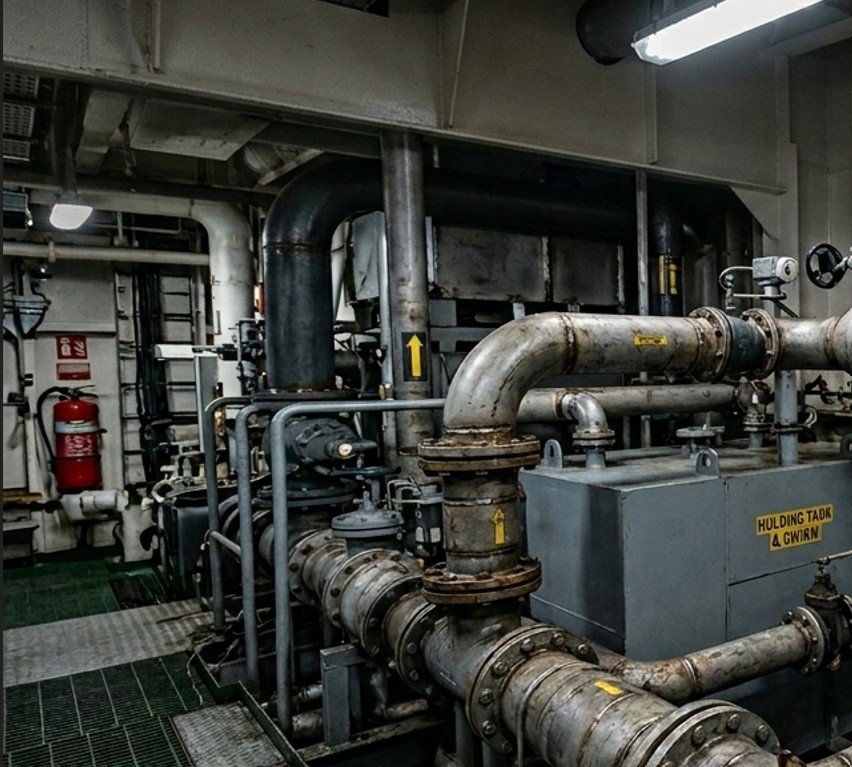
When a ship’s black water system starts causing trouble such as persistent odors, vacuum loss, blocked WC discharge, or unexplained flooding, the first instinct is to point at the sewage treatment plant. Crew raise a defect report, the port agent lines up a service technician, and a day later someone is elbow-deep.
But in reality, the treatment plant, in most cases, is doing exactly what it was designed to do. The problem started somewhere in the 200 or 500 metres of piping that feeds it.
In the end, ships have spent port calls chasing “phantom treatment unit failures” when the actual fault was a poorly routed branch line installed during the original build or a recent retrofit.
Other technical inspections and interventions have been carried out in an attempt to “solve” recurring odor complaints. The reality is that pipe routing and fitting in black water systems are extremely important, and black water piping engineering is a discipline that does not receive the attention it deserves.
Quick facts — black water piping design
- MARPOL Annex IV applies to ships of 400 gross tonnes and above, or certified to carry more than 15 persons
- Vacuum sewage systems typically use 1.2 litres per flush — a fraction of gravity systems’ water consumption
- Pipe diameters in vacuum systems are typically 50-100 mm, smaller than gravity drainage equivalents
- Sulfide corrosion follows the same electrochemical mechanism seen across marine wastewater systems: H₂S gas oxidises at the pipe crown to form sulfuric acid (H₂SO₄)
- Material choice (carbon steel with coating, 316L stainless, or CPVC) must account for a typical 25-year vessel service life, not just initial installed cost
The Piping Is the System
Under MARPOL Annex IV, any ship of 400 gross tonnes and above engaged on international voyages, or certified to carry more than 15 persons, must be equipped with an approved sewage treatment plant, a comminuting and disinfecting system, or a holding tank of adequate capacity.
The regulation defines the endpoint, but it doesn’t say anything about what happens between the toilet and the treatment unit.
That gap, the collection and transport network, is where the majority of operational failures originate.
Modern vessels generally use vacuum-based black water collection systems (the famous vacuum jet-pumps). Vacuum systems bring specific design characteristics that make failures more likely if not properly engineered:
- Lower water consumption per flush,
- Reduced Pipe diameter compared to gravity drainage
- Pipe Layout “too much” flexible across multiple decks and hull sections.
A vacuum collection generates negative pressure across the piping network to transport waste from WC to a central collection point, from where it is either processed onboard or retained for shore discharge.
Where the Problems Begin: Pipe Routing Geometry
The most underestimated source of failure in vacuum sewage systems is the geometry of the piping arrangement itself.
In a gravity drainage system, the rule is simple: mantaining a pipe sloop towars the discharge or draining tank, maintain the minimum inclination grades, avoid flat sections. Vacuum systems are more forgiving about vertical routing but they demand precision in the design of what are called transport pockets: deliberate dip sections in the pipe run that accumulate a liquid plug before vacuum-driven transport carries it forward through the system.
- Get these right and the system moves waste efficiently, spool by spool, with the vacuum intact..
- Get them wrong and the consequences compound quickly.
What Transport Pockets Do and Why They Must Be Precise
Long horizontal pipe runs without proper pocket geometry create turbulent and unstable two-phase flow conditions. Air and liquid cease to travel together in a defined flow regime.
Instead, air pockets form at high points, and as a result, the vacuum that depends on a defined flow condition and a fully saturated pipe section decreases.
How a Vacuum Loss Gets Misdiagnosed as a Toilet Fault
When these conditions occur, the toilet appears to have weak suction. In reality, the transport line is partially air-locked somewhere between the toilet and the collection tank.
Incorrect pipe slopes, which cause improper air-liquid flow and therefore vacuum losses, have a compound effect.
Solids deposition is one of the direct consequnces of the an incorrect flow phenomena above. This incorrect flow condition leads directly to solids deposition, which has collateral effects:
- it reduces effective pipe bore,
- creates anaerobic micro-environments where biological activity intensifies,
- and generates gas that further disrupts the vacuum.
Improperly positioned vacuum pockets, too shallow, too close together, or placed at the wrong points, mean the system never achieves the hydraulic conditions needed for stable transport.
The result is a cyclic failure: the vacuum pump activates, achieves partial vacuum, partially transports waste, loses pressure, recovers, and repeats.
None of this is visible during a system inspection unless the inspector understands what to look for.
Corrosion: The Slow Failure No One Prices In
Piping geometry is the real problem. Corrosion is the chronic one, and in many ways the more expensive of the two over the life of the vessel.
Black water piping operates in one of the more aggressive internal environments found onboard a ship.
The pipe wall is continuously exposed to biological media carrying organic acids and sulfur compounds.
How Sulfide Attack Develops
The corrosion mechanism most relevant to sewage piping is sulfide attack. Under anaerobic conditions, which arise exactly where flow stagnates:
- in dead legs,
- in low-gradient flat sections,
- in improperly designed pockets
Sulfate-reducing bacteria metabolize sulfate present in the wastewater and generate hydrogen sulfide gas (H₂S). This gas migrates into the pipe crown space above the liquid surface. There, in contact with moisture and aerobic bacteria at the pipe wall, it oxidizes to sulfuric acid (H₂SO₄).
Sulfuric acid attacks both ferrous metal pipe and cementitious pipe linings with speed and consistency.
Choosing Materials for a 25-Year Service Life
Material selection is therefore not a secondary consideration. It is a primary design decision.
For black water service, the options available to thedesigner include:
- Carbon steel with internal coating
- Stainless steel grades such as 316L with its molybdenum content providing resistance to chloride-induced pitting,
- Thermoplastic materials including CPVC, which offer excellent chemical resistance
Each carries different performance profiles, different installed costs, and different maintenance demands over a 25-year vessel life.
Poor material selection in a black water system manifests quietly, in a short section of pipe behind a panel somewhere in the accommodation block, sometime in the vessel’s third or fourth year of service.
Why Design Discipline Matters
A poorly designed black water system onboard can cause serious issues, and in the superyacht industry, where luxury is paramount, this can be a total disaster for superyacht brands and yacht management companies.
For this reason, it is fundamental to design the system properly from the outset, selecting the right materials, correctly sizing the pipes, and placing the transport pockets in the right positions to ensure robust vacuum performance and, therefore, a perfectly functioning system.
At Flowazur Consulting, we have designed, inspected, and commissioned several black water systems. This allows us to support shipyards and/or shipowners during the design phase and during onboard inspections, detecting issues before they become problems for ship operability and its crew.
Book a call with one of our engineers to discuss your project in detail.
Frequently Asked Questions
Q: Why does a black water treatment plant get blamed for problems it didn’t cause?
A: Because the fault is usually invisible from the treatment plant itself — it sits upstream, in 200 to 500 metres of piping between the toilets and the collection point. A poorly routed branch line or badly positioned transport pocket produces symptoms, like weak suction or bad odors, that look like a treatment unit failure but aren’t.
Q: What is a transport pocket in a vacuum sewage system?
A: A deliberate dip section in the pipe run that accumulates a liquid plug before vacuum-driven transport carries it forward. Positioned and sized correctly, it keeps the system moving waste efficiently; positioned wrong, it causes air pockets, vacuum loss, and cyclic transport failure.
Q: Which ships need a sewage treatment plant under MARPOL Annex IV?
A: Any ship of 400 gross tonnes and above engaged on international voyages, or any ship certified to carry more than 15 persons, must be equipped with an approved sewage treatment plant, a comminuting and disinfecting system, or a holding tank of adequate capacity.
Q: What causes corrosion inside black water piping?
A: Sulfate-reducing bacteria thriving in anaerobic conditions, such as dead legs or low-gradient sections, generate hydrogen sulfide gas. This gas migrates to the pipe crown and oxidises in the presence of moisture into sulfuric acid, which attacks both ferrous pipe and cementitious linings.
Q: What pipe materials are used for black water service on ships?
A: Common options include carbon steel with internal coating, stainless steel grade 316L for resistance to chloride-induced pitting, and thermoplastics such as CPVC for their chemical resistance — each with different installed cost and maintenance profiles over a vessel’s service life.