
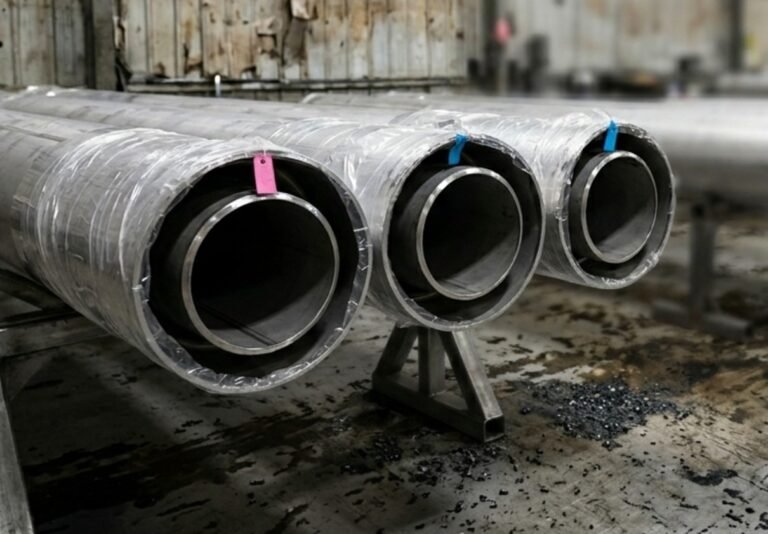
Under MSC.1/Circ.1621, the Interim Guidelines for the Safety of Ships Using Methyl/Ethyl Alcohol as Fuel, routing a low-flashpoint fuel such as methanol through an enclosed or safe area requires a double barrier. For methanol fuel tanks, that protection comes from the cofferdam arrangement around the tank.
In pipelines, the same principle is achieved through double-walled pipe.
The reasoning behind this philosophy is this: working with methanol means reducing, as much as possible, the likelihood of leakage and the hazardous vapours that would follow.
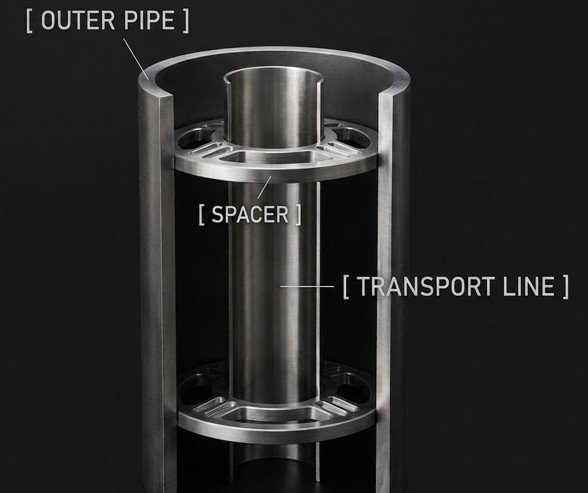
Double-walled pipes for methanol are of the jacketed pipe type, meaning they consist of:
- An inner pipe, which transports the fuel.
- An outer pipe, which acts as a containment unit.
In practical terms, if the methanol-carrying inner pipe suffers a structural failure, a crack, the hazardous fuel is fully contained within the outer pipe. For piping designers and technical offices, working with this pipe technology means assessing several key aspects:
- The space required to install the double-walled pipe onboard.
- Support arrangements to keep vibration to a minimum.
- Nitrogen purging branches or airflow provisions for the annular space
Quick Facts
– Methanol flow velocity in the inner pipe stays between 1.0 and 2.5 m/s to control erosion and pressure drop
– The annular space between the two pipes must be ventilated at 30 air changes per hour, per the IGF Code family and MSC.1/Circ.1621
– Internal spacers are typically spaced 1.5–2.5 m apart, tightened near elbows and valve manifolds
– The annular space is protected either by active mechanical ventilation or by sealed nitrogen inerting at ≤5% oxygen content
– Double-walled spools are prefabricated and cannot be adjusted on-site with standard pipe-fitting methods
Sizing the Inner Transport Pipe
The inner core pipe handles the methanol flow. It’s sized using standard fluid mechanics to keep fluid velocity within the safe, erosion-free limits classification societies call for typically between 1.0 and 2.5 m/s.
Methanol’s kinematic viscosity is low, in the order of 0.74 cSt at 20°C (roughly a third of water’s), so the flow profile turns turbulent quickly, accelerating pressure drops along the pipeline. Engineers need to select the inner diameter (Di) carefully to avoid localised pressure drops. Skipping the pressure drop assessment is particularly risky in suction pipes, where negative pressure combined with elevated losses can reach methanol’s vapour pressure, causing part of the fluid to flash into vapour bubbles.
Sizing the Outer Jacket Pipe
The internal diameter of the outer jacket (Dj) is governed by the cross-sectional area the annular space needs the gap between the two pipes.
Where that space is monitored by continuous mechanical ventilation, the well-established “30 air changes per hour” (ACH) rule that runs through the IGF Code family of low-flashpoint fuel provisions, and that MSC.1/Circ.1621 carries over for methanol, sets the benchmark ventilation rate for the annulus.
To calculate the minimum outer jacket size, engineers determine the free volumetric flow rate Qvent needed to achieve 30 ACH over a given pipe length (L):

Qvent: Volumetric ventilation/purge flow rate [m3/h]
V annular: Volume of the annular space. [m3]
D j: Larger diameter (e.g., borehole diameter or outer casing diameter). [m]
d o: Smaller diameter (e.g., outer diameter of the inner pipe). [m]
L: Length or depth of the considered section. [m]
30: Constant multiplier of your specific model (e.g., air changes per hour or safety factor).
IMPORTANT NOTE
If Dj is sized too close to do, the small annular space area may create excessive pneumatic friction. This throttles the ventilation air supply, overloads the exhaust fans, and potentially causes one or more underventilated spots where leaks, if they arise, are not properly ventilated.
Internal Spacer Design for the Double-Walled Pipe
The inner transport pipe doesn’t rest against the bottom of the outer jacket, it’s held on the centreline using internal spacers (centring rings).
Spacers have to satisfy three design requirements:
- Minimal flow restriction: spacers should use segmented shapes, spiders with localised metallic legs, or machined quadrants rather than solid rings. That keeps the annular cross-section open, letting ventilation air or nitrogen flow without significant pressure drops.
- Material compatibility and rubbing mitigation: as the inner pipe expands and contracts through thermal cycles, it can slide axially. Stainless steel spacers rubbing directly against a stainless outer jacket can gall cold-welding under friction. To prevent that, spacers get non-metallic, low-friction, methanol-resistant wear pads, typically virgin PTFE (Teflon) or PEEK.
- Structural pitch (spacing distance): the span between spacers has to be calculated with beam deflection formulas to stop the inner pipe sagging under its own weight when full of fuel. A span of 1.5–2.5 m is typical, tightened up near elbows and heavy valve manifolds.
Annular Space Monitoring and Venting Configurations
The annular space must be continuously managed using one of two class-approved monitoring and mitigation philosophies:
- Active Mechanical Ventilation
- Nitrogen (N2) Gas Inerting.
Option A: Active Mechanical Ventilation (Underpressure Configuration)
This configuration uses a centrifugal exhaust fan to intake ambient air through the annular space at 30 ACH, keeping the channel at a slight negative pressure relative to the machinery room.
The safety logic: because the channel runs under negative pressure, a breach in the outer jacket could, in principle, let the vacuum work and allow a leak to pass through the defect without being swept into the exhaust stream. That’s exactly why assembly-phase quality control, avoiding any damage to the outer jacket, matters as much as the design itself.
Instrumentation interface: rapid-response gas sensors, infrared or detectors are both used in practice, sit directly in the exhaust air stream. If a leak occurs, the sensor picks up methanol vapour and trips the main Fuel Supply System (FSS) Emergency Shutdown (ESD) valves, isolating the fuel line within seconds.
Option B: Sealed Nitrogen Gas Inerting (Overpressure Configuration)
This configuration fills the annular space with high-purity nitrogen oxygen content not exceeding 5% by volume, consistent with the purity level the Interim Guidelines require for methanol inerting systems generally, at a static pressure higher than both the internal fuel pressure and the ambient engine room pressure (high-pressure double-walled pipe excluded).
The monitoring mechanism: the sealed annular zone carries pressure transmitters. If the inner transport pipe leaks, the higher nitrogen pressure forces its way into the lower-pressure fuel pipe, a fraction of nitrogen migrates into the fuel line, triggering a low-pressure nitrogen alarm. If the outer jacket fails instead, nitrogen leaks into the engine room, again triggering a low-pressure alarm.
Application focus: this arrangement is favoured for short, complex piping runs near the engine manifold, where running continuous ventilation ducting just isn’t practical given the space.
Fabricating and Testing Double-Walled Spools
From a practical shipyard standpoint, double-walled piping systems cannot be adjusted on-site using standard pipe-fitting methods.
They are manufactured as highly engineered, prefabricated spools. Therefore, the piping engineering behind them must be thoroughly executed to avoid difficult and costly rework onboard with this type of pipe technology.
Many skilled technical offices lack the expertise to work with this technology, increasing project risk during the assembly phase.
At Flowazur Consulting, we support shipyards and shipowners during the feasibility study and piping engineering of methanol-as-fuel projects, both newbuilding and retrofit, reducing uncertainty within the engineering team and lowering overall project risk.
Book a call with one of our engineers to discuss your project in detail.
Frequently Asked Questions
Q: What is a double-walled pipe for methanol fuel?
A: A jacketed pipe design where methanol flows through the inner pipe and an outer pipe fully contains any leak if the inner pipe fails.
Q: What velocity should methanol flow at in the inner pipe?
A: Between 1.0 and 2.5 m/s, to stay within the safe, erosion-free limits classification societies call for.
Q: What is the 30 ACH rule for double-walled pipe?
A: The requirement, carried over from the IGF Code into MSC.1/Circ.1621, that the annular space be ventilated at 30 air changes per hour.
Q: What material are pipe spacers made from?
A: Non-metallic, methanol-resistant wear pads, typically virgin PTFE or PEEK, to prevent galling between stainless steel surfaces.
Q: Mechanical ventilation or nitrogen inerting for the annular space?
A: Active ventilation suits longer runs with practical ducting access; sealed nitrogen inerting suits short, complex runs near the engine manifold where ducting isn’t practical.
Q: Can double-walled pipe be adjusted on-site during installation?
A: No. it’s manufactured as a prefabricated, engineered spool and can’t be field-adjusted with standard pipe-fitting methods.