
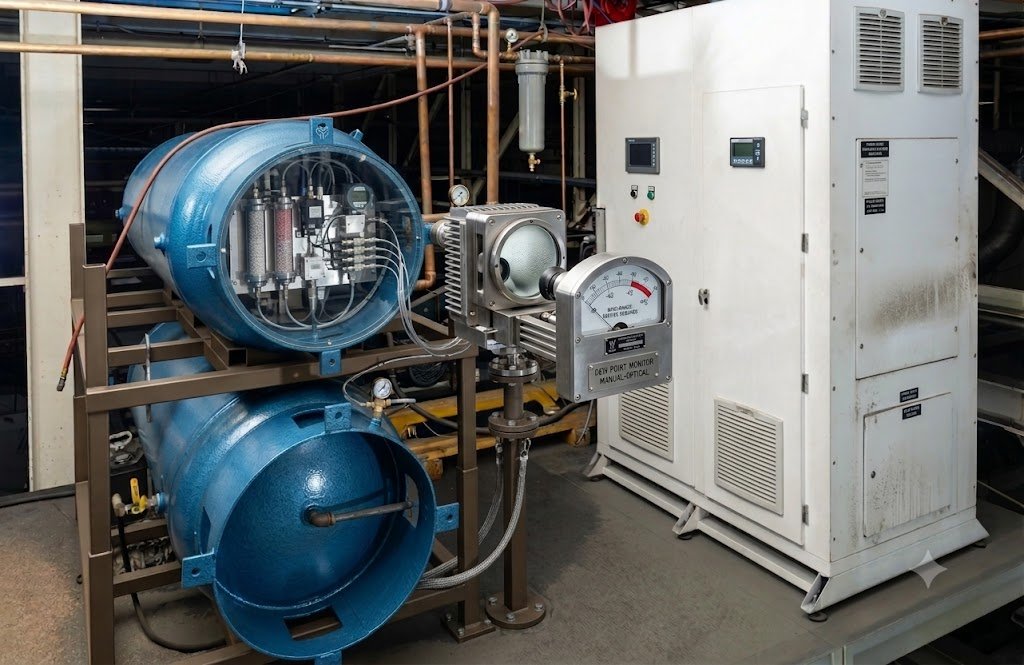
Operating a methanol-fueled vessel requires a shift in the working philosophy applied to managing fuel tank ullage spaces and hazardous areas such as the fuel preparation room.
Unlike traditional heavy fuel oil (HFO), methanol has a low flashpoint of only 11–12°C.
This means it evaporates quickly in most operational conditions onboard, given that ambient temperatures, particularly in the vicinity of the engine room, typically exceed 15°C.
Once evaporated, methanol generates a flammable and explosive atmosphere, with a Lower Flammability Limit (LFL) of around 6.7% by volume in air. To prevent that vapour from forming in the first place, maintaining a permanent, active inert gas blanket is a strict statutory requirement; and get this wrong, and you’re not looking at a minor deficiency, you’re looking at a flammable tank atmosphere. The heart of this safety infrastructure is the Nitrogen (N2) Generator Room.
As the project progresses from feasibility study to basic engineering, where piping calculations are performed, engineering teams frequently encounter two critical thermodynamic parameters that classification societies pay close attention to:
- Nitrogen purity
- Pressure dew point
Failing to calculate and control these parameters risks system-wide corrosion and the formation of explosive vapour mixtures.
Quick Facts
– Class rules cap oxygen content in the methanol tank vapour space at 8% by volume at all times
– The nitrogen system must hit both a purity target and a pressure dew point low enough to prevent moisture condensation in piping and tanks
– Hollow-fiber membrane generators are the preferred choice for most methanol retrofits due to their compact footprint
– A twin-tower desiccant air dryer upstream of the generator is required to hold a consistently low dew point
– Double block-and-bleed valves plus non-return valves are mandatory at every point where nitrogen injects into methanol lines
Thermodynamic Baseline: What is Pressure Dew Point?
In marine engineering, the Pressure Dew Point (PDP) is the temperature at which water vapour suspended within a compressed gas system begins to condense into liquid water at a specific operating pressure.
It differs from the atmospheric dew point because compressing a gas concentrates the water molecules, significantly raising the temperature at which condensation occurs.
If the nitrogen gas injected into a methanol tank has an inadequate, excessively high PDP, the temperature drop experienced by the gas during expansion or during cold-weather voyages will cause liquid moisture to condense out.
Because methanol is hygroscopic, it readily absorbs this water. This degrades fuel quality, alters the flashpoint, and accelerates corrosive microbial growth and pitting within stainless steel storage tanks and pipelines.
Class Regulatory Requirements for Methanol Inerting
The design of onboard nitrogen generation rooms is governed by the IMO Interim Guidelines for the Safety of Ships Using Methyl/Ethyl Alcohol as Fuel (MSC.1/Circ.1621), together with the class rules that incorporate them such as DNV-RU-SHIP Pt.6 Ch.2 and Lloyd’s Register’s Rules for Low Flashpoint Fuelled Ships.
Class societies treat the nitrogen system as safety-critical, and design it around a clear performance target rather than a fixed recipe.
1. Oxygen Content and Tank Inerting
The requirement that matters most in practice is the one at the tank itself: the vapour space of the methanol fuel tank is to be inerted at all times so that the oxygen content does not exceed 8% by volume at any point in the tank, well below the Limiting Oxygen Concentration for methanol vapour. A high-oxygen-content alarm is to be fitted in the engine control room in addition to any local monitoring.
To hold that 8% ceiling with a safe margin under operating conditions, venting during bunkering, consumption rate, temperature swings; the nitrogen supplied to the blanket needs to be of high purity. The exact purity figures are set by the class society for the specific installation;
2. Pressure Dew Point Restrictions
To prevent condensation inside fuel piping and storage tanks, the pressure dew point of the generated nitrogen needs to stay comfortably below the lowest ambient design temperature the vessel is expected to see, across its full trading range, at the system’s operating pressure, the exact margin and reference values are agreed with the class society as part of the approval, based on the vessel’s intended service.
Achieving a consistently low PDP requires an efficient pre-treatment and drying sub-system upstream of the nitrogen separation stage. In practical terms, what we want is a sub-system able to strip as much moisture as possible out of the feed air before we ever try to extract nitrogen from it. Chase the PDP number after the fact, and you’ll end up reworking an already-finished nitrogen room onboard.
Technology Choice: Membrane vs. PSA for a Constrained Footprint
Generating this high-purity, low-PDP nitrogen within the tight spatial confines of a vessel’s machinery casing usually comes down to selecting between two core technologies:
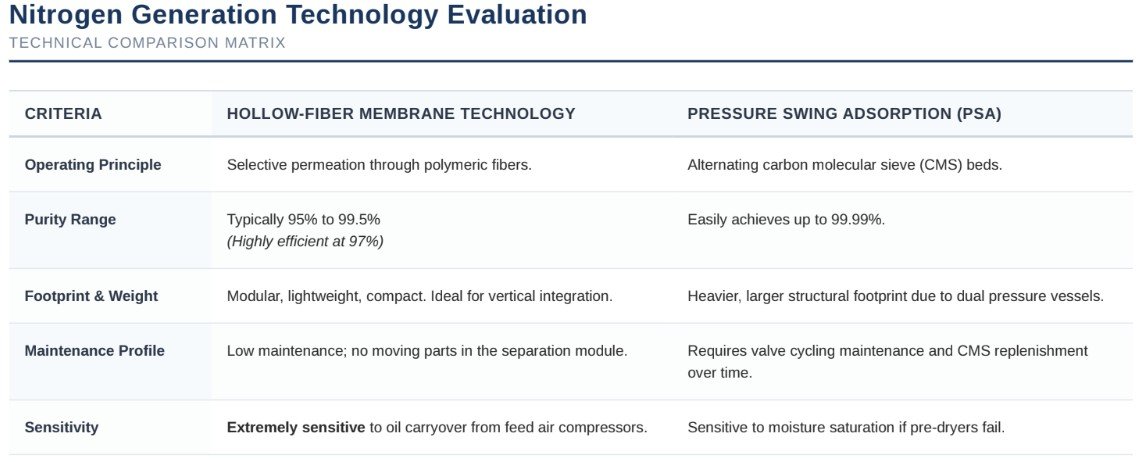
For most methanol retrofits and newbuilds with space constraints, Hollow-Fiber Membrane technology is the preferred choice for nitrogen generation, owing to its compactness and efficiency. However, once compressed feed air containing liquid water or oil mist from the screw compressors enters the membrane, the micro-pores of the hollow fibers will foul permanently, causing an immediate drop in nitrogen purity
Multi-Stage Filtration and Air Drying
To hold a consistently low PDP, relying solely on the air dryer is not enough. The nitrogen room layout must integrate a dedicated, twin-tower desiccant adsorption air dryer downstream of the coalescing filters.
This unit uses activated alumina or molecular sieves to scrub moisture from the feed air before it reaches the nitrogen generator.
Maintenance access is one of the most critical factors to get right at layout stage. Positioning filter housings against structural bulkheads, where crew members can’t physically reach the elements for maintenance, is a classic engineering error, and one that’s expensive to fix once the room is built.
Ventilation and Asphyxiation Risk Management
During nitrogen generation, the waste product is an oxygen-enriched gas stream vented from the separation process. Conversely, any component leak within the room can create a localized, asphyxiating nitrogen-rich environment and because nitrogen is odourless and colourless, a crew member can walk into a dangerously depleted atmosphere without any warning at all.
- Mechanical Ventilation: The nitrogen generator room needs its own independent mechanical extraction ventilation system. The exact air-change rate is confirmed with the class society based on room volume and layout; it’s a different figure from, and shouldn’t be assumed equal to, the 30 air changes per hour mandated for the fuel preparation room and for the annular space of double-walled fuel piping.
- Discharge Piping: The oxygen-enriched waste gas vent must be routed via fully welded stainless steel piping directly to a designated safe location on the open deck, away from any potential ignition sources or HVAC intakes.
- Ambient Monitoring: Redundant, class-approved oxygen content sensors linked to audible and visual alarms must be permanently installed inside the space to protect the crew.
Non-Return Safety Controls
Because the nitrogen system directly interfaces with hazardous methanol lines and tanks during blanketing and purging sequences, there’s a real risk of liquid methanol back-flowing into the nitrogen branches and pipelines.
Class societies strictly mandate double block-and-bleed valve arrangements, combined with heavy-duty mechanical non-return valves, at every connection point where nitrogen is injected into methanol pipes or tanks.
Engineering the System, Not Just the Component
Selecting the right nitrogen generator consists of defining the correct regulatory framework and requirements, and then choosing the appropriate machinery.
In marine engineering, only a small number of merchant vessels use nitrogen onboard, and therefore few technicians are well acquainted with nitrogen generation technologies and their requirements.
This is especially true for vessels running on methanol, where class requirements for nitrogen are stricter, as the nitrogen system is one of the most critical safety systems for this type of vessel.
Furthermore, nitrogen flow rate calculations must be performed to estimate the required production capacity needed to keep the methanol fuel system and tanks safe under all operating conditions.
An incorrect layout for the nitrogen generator and associated filtration units, or worse, an incorrect flow rate calculation, can lead to costly rework onboard, causing shipowner dissatisfaction, additional expenses and project delays.
At Flowazur Consulting, our piping design service covers methanol-as-fuel projects in full, defining all the branches where nitrogen must be injected and dimensioning all the components, nitrogen generator included. clear engineering output that drives a calculated, risk-free procurement.
Frequently Asked Questions
Q: Why does a methanol-fuelled ship need a nitrogen generator?
A: Methanol’s low flashpoint means its vapour is highly flammable, so the fuel tank ullage space must be permanently blanketed with nitrogen to prevent an explosive atmosphere.
Q: What oxygen level must the nitrogen blanket maintain?
A: Class rules require the vapour space of the methanol fuel tank to stay at or below 8% oxygen by volume at all times.
Q: What is pressure dew point and why does it matter here?
A: It’s the temperature at which water vapour in the compressed nitrogen starts to condense; too high a dew point lets moisture into the methanol, degrading fuel quality and causing corrosion.
Q: Membrane or PSA nitrogen generator for a methanol retrofit?
A: Hollow-fiber membrane technology is generally preferred for methanol projects because of its compact footprint, though it’s more sensitive to fouling from liquid water or oil mist in the feed air.
Q: What guidelines govern methanol nitrogen systems?
A: MSC.1/Circ.1621, together with class rules that incorporate it such as DNV-RU-SHIP Pt.6 Ch.2 and Lloyd’s Register’s Rules for Low Flashpoint Fuelled Ships.
Q: What prevents methanol from flowing back into the nitrogen lines?
A: Double block-and-bleed valve arrangements combined with heavy-duty non-return valves at every nitrogen injection point.