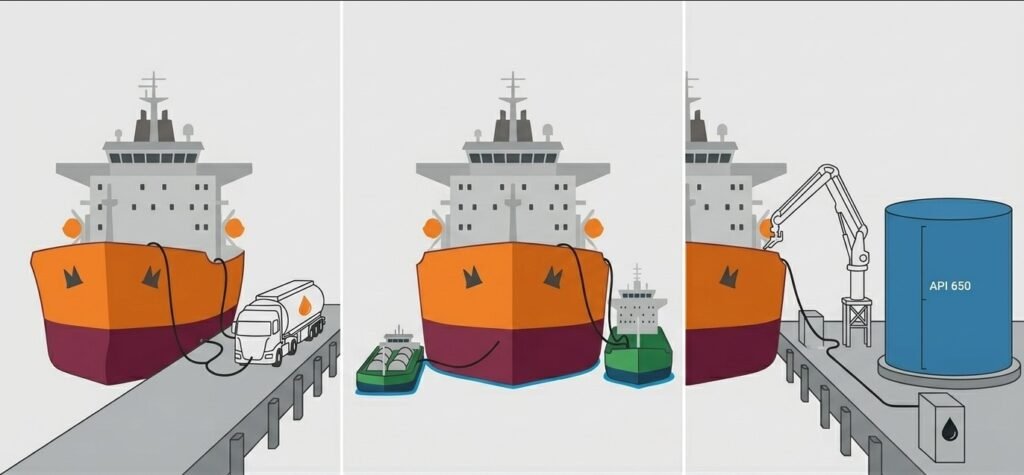
During a methanol bunkering operation, the ship and the shore terminal or bunker barge operate as a single, integrated piping system.
Due to methanol’s low flashpoint and vapour toxicity, any operational anomaly, a storage tank in HH level, a sudden pressure spike, a hose issue at the manifold, can turn into a spill or a fire in a matter of seconds if the two sides of the transfer aren’t reacting together.
Achieving a synchronized response requires a robust Emergency Shutdown (ESD) system that directly links the vessel’s automation system with the supplier’s control infrastructure. Without that link, an ESD triggered on board doesn’t necessarily stop the pumps ashore, and the ship can end up isolating its own piping while product keeps being pushed into a closed line, which is exactly the kind of overpressure event that ruptures hoses and damages manifolds.
Under the IMO Interim Guidelines for the Safety of Ships Using Methyl/Ethyl Alcohol as Fuel (MSC.1/Circ.1621, paragraph 8.5.3), a ship-shore link or an equivalent means for automatic and manual ESD communication with the bunkering source has to be fitted. If a fault occurs on either side, both systems are expected to shut down safely, without inducing water hammer, overstressing the piping or causing a major release.
"A ship-shore link (SSL) or an equivalent means for automatic and manual ESD communication to the bunkering source should be fitted"
IMO - IGF CODE GUIDELINES FOR THE SAFETY SHIPS USING MeOH AS FUEL
Quick Facts
– MSC.1/Circ.1621 (para 8.5.3) requires a ship-shore link, or an equivalent means, for automatic and manual ESD communication with the bunkering source.
– Fibre optic links are preferred in the Zone 1 area around the manifold.
– Electric SSL connectors rely on intrinsically safe (Ex ia) loop currents — breaking the loop, triggers a shutdown on both sides.
– ESD Stage 1 stops transfer pumps and closes manifold valves on a controlled, timed sequence to avoid a water hammer.
– ESD Stage 2, where fitted, escalates to an Emergency Release System (ERS).
The Ship-to-Shore Link (SSL) system
The Ship-to-Shore Link is the physical and digital interface bridging two completely independent control systems, translating and relaying safety signals between the vessel’s automated monitoring system and the shore-side infrastructure. In practical terms it works as a bunkering supervisor, continuously watching pressure and level throughout the transfer.
If an anomaly arises, it reports it to both the bunkering facility and the vessel and triggers an ESD on both sides at once.
Methanol lacks its own dedicated body of ESD/SSL standards, so the industry has, sensibly, extended practice built up over decades on LNG and LPG transfers.
The relevant reference documents are SIGTTO’s ESD Systems guidance and the joint OCIMF/CDI paper on linked ship/shore emergency shutdown systems for oil and chemical transfers; both of which set out the functional requirements, connector types and testing philosophy that methanol bunkering interfaces are being built around today.
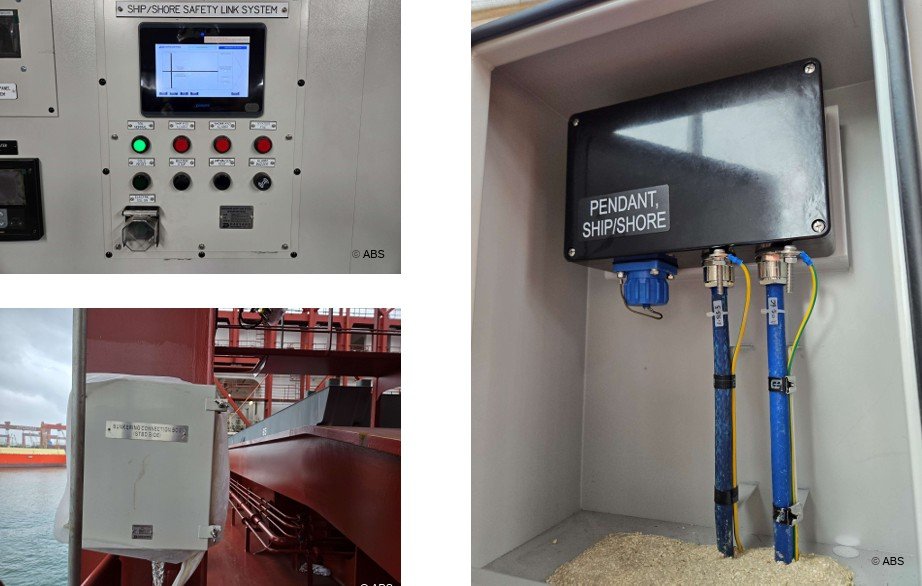
Photo Source: ABS – Methanol Bunkering Workshop
The Ship-to-Shore Link can be implemented using different technologies:
- Fibre optic links. Preferred for modern low-flashpoint fuel bunkering because they’re immune to electromagnetic interference and remove electrical ignition sources from the loop entirely. This makes them well suited to the Zone 1 hazardous area that surrounds the bunkering manifold. The Interim Guidelines classify the open-deck area within 3m of any methyl/ethyl fuel valve, flange or vapour outlet as Zone 1, and a fibre link carries no electrical energy that could act as an ignition source there.
- Electric links. Industry practice (SIGTTO and OCIMF/CDI) standardises on a handful of pin configurations; 5-pin twist connectors for oil and chemical transfers, and 6-pin or 37-pin electric connectors more commonly seen on gas carriers; rather than any single proprietary design. These rely on intrinsically safe (Ex ia) loop currents: breaking the loop, deliberately or by accident, immediately triggers a shutdown on both sides. Which connector type ends up fitted is really a function of what the terminal already has, so compatibility is worth checking well before the first bunkering call, not on the day.
- Pneumatic links. Used mainly when interfacing with barges or simpler terminal setups. A pressurised air line runs between ship and shore; if pressure drops below the setpoint fixed during system design, an ESD is triggered on both ends. We’d rather not put a number on the typical setpoint here, since it’s an engineering choice made case by case and not something fixed by a recognized standard.
The ESD working philosophy
A properly designed safety interlock system shutdown following a defined sequence and timing.
Abruptly arresting machinery or closing rapidly valves can do more harm than the fault it’s reacting to. On a bunkering line, for instance, an instantaneous valve closure following an ESD can generate a water hammer, with spill effects and overstress on the piping, sometimes worse than the original anomaly.
A gradual, timed closure is what keeps the line isolated without turning the shutdown itself into the incident; exact closure times are set through a transient (surge) analysis specific to line length, flow velocity and valve type, and should never be assumed from another vessel’s settings.
ESD Stage 1
Triggered by process issues such as a storage tank High-High level alarm, a vapour detection alarm, or a manual emergency pushbutton activated by an operator.
Note that the Interim Guidelines require the High-High alarm to act independently of the ordinary High-level alarm, precisely so a single sensor fault can’t mask an high level scenario. However guidelines don’t set a fixed percentage of tank capacity for the setpoint; that figure is fixed by the shipyard/owner during design and should be checked against the vessel’s own fuel handling manual rather than assumed. The following sequence occurs:
- The vessel’s ESD system instantly transmits a trip signal across the SSL link.
- The shore-side control system receives the signal and begins stopping its transfer pumps.
- Concurrently, the vessel’s automated manifold valves begin a controlled closing sequence to isolate the onboard tanks, timed to avoid a water hammer event.
ESD Stage 2
Not all methanol bunker systems incorporate this second barrier of protection. The second ESD stage is dedicated to extreme physical events, such as a bunker barge moving beyond safe operational limits due to wave action, or a fire breaking out on deck. In practical terms, where installed, the ESD system progresses into an Emergency Release System (ERS) sequence:
- The system immediately initiates a Stage 1 pump shutdown.
- The dry-break couplings at the manifold release through a Powered Emergency Release Coupling (PERC) a coupling designed to use stored energy (hydraulic, pneumatic or spring, depending on the manufacturer) to force a clean breakout
- The hoses or loading arms separate cleanly with minimal leakage, protecting both the vessel’s structural manifold and the environment.
We’d add one point that often gets skipped in procedures built around this sequence: a PERC is a last-barrier, not a routine disconnection method, and every activation, real or during testing, should be followed by a full inspection of the dry-break faces before the coupling goes back into service.
SSL integration in Bunkering system
Integrating the Ship-to-Shore Link requires a deep understanding of automated safety logic, electrical safety protocols, and the fluid dynamics of high-volume fuel transfers.
Integrating this system without a solid knowledge of its working philosophy can easily lead to incorrect conclusions and, therefore, to solutions rejected by the classification society during the approval process or, in the case of incorrect shutoff valve timing, to major damage during commissioning.
As a consequence, rework is required to bring the system safety in line with the required standards.
At Flowazur Consulting, our marine piping engineering service supports EPCs, shipyards, and engineering teams on methanol-as-fuel projects — reducing uncertainty while simplifying the engineering process.
Book a call with one of our engineers to discuss your methanol project
Frequently Asked Questions
Q: What does MSC.1/Circ.1621 require for methanol ship-to-shore communication?
A: Paragraph 8.5.3 requires a ship-shore link, or an equivalent means, for automatic and manual ESD.
Q: What triggers an ESD Stage 1 during methanol bunkering?
A: A storage tank High-High level alarm, a vapour detection alarm, or a manual emergency pushbutton.
Q: What happens during ESD Stage 2?
A: Not all systems include it. Where fitted, it escalates into an Emergency Release System (ERS): a Powered Emergency Release Coupling (PERC) forces the hoses or loading arms.
Q: What SSL connector types does the industry use?
A: SIGTTO and OCIMF/CDI practice standardises on 5-pin twist connectors for oil and chemical transfers, and 6-pin or 37-pin electric connectors more common on gas carriers – the exact type depends on what the terminal already has.