
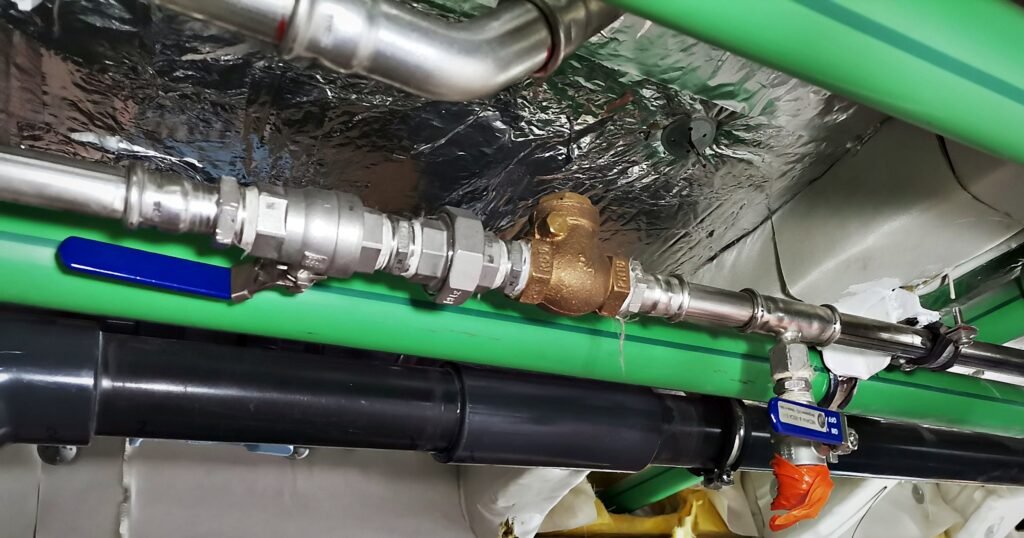
On a superyacht, the pipe is the cheapest part of a piping refit.
Behind the crew mess ceiling and the cabin panels, every meter of pipe means more joinery to remove, interiors to protect, tests to run and class to satisfy. That’s where budgets break
At Flowazur Consulting, we support chief engineers, owner’s representatives and management companies in major superyacht piping refit projects:
- Survey onboard
- Work List (items to be refitted)
- Ready for the yard to price, before the quote
- Supervision and technical management
Why Piping Is the Refit Item That Breaks Budgets
Superyachts are bought for their lines, their interiors and their amenities. Piping stays out of sight, so it’s easy to treat it as a second priority when the refit budget is drawn up.
Yet every service onboard depends on piping systems that run through the whole general arrangement. And that’s the main problem.
Most pipes can be inspected. At worst, they’re covered by D-Bond.
Pipes run behind furniture and delicate, expensive lining panels.
As a result, many lines aren’t properly surveyed before the yacht arrives at the shipyard, and hidden items appear once the refit has started.
What a Piping Refit Really Pays For
The pipe work itself isn’t the most expensive part. Quite the opposite:
€500–1,000
The typical cost of a small piping item, even in an expensive material as cunipress.
So why does piping break budgets? Because of everything around the pipe:
- hidden jobs found once the panels come off
- removal of furniture and interior parts, which needs specialist work
- pressure testing
- class approval of the marine systems involved
- mobilisation and demobilisation of workers
- cleaning and reassembly of everything
The pressure test deserves a line of its own. It puts old parts of the line under extra pressure. They start leaking, and now there’s another item to refit.
The single spool isn’t the problem. The entire operation can be.
Piping as an Asset Decision
A large share of the fleet is entering its first or second major refit cycle after the construction boom of the 2000s and 2010s (Monaco Life). Much of the pipework onboard has now been in service for 10 to 20 years.
The Fleet Needs also Retro-Refit Projects
A major refit can also include equipment replacement. Replacing an old chiller or black water treatment unit means a totally different work scope from refitting a few problematic pipe spool or fitting. When larger or substantially different equipment has to be installed, we strongly advise a feasibility study to avoid any (big) surprise during the refit window.
Pipe Renewal Across Refit Cycles
On second refits, the metres of old pipe are often considerable and the work list is long. The chief engineer, together with the second engineer and/or a superintendent, must decide which works are carried out immediately and which can wait for the next yard period. Plan it across the cycle: this refit, the next one, the one after.
This analysis needs extreme care. One important item left out can cause problems at sea, or with guests onboard.
Documentation as Asset Value
A superyacht is a high-value asset on the market, and an asset like that needs its documents, certificates and papers well organised. For the marine systems onboard, that means:
- ✓Updated P&IDs
- ✓As-built pipe routes
- ✓Valve and equipment drawings
- ✓Type approval certificates for the equipment and parts installed
- ✓Pressure test reports signed by all parties
- ✓Commissioning documents signed by all parties, when new equipment is installed
Building the Technical Work for the Management Company
Evidence That Gets a Budget Approved
As we explained in our guide to superyacht refit engineering, yacht management companies are the “invisible engine” of the refit. They collect the input from the crew and manage yards, contractors, quotes and the experts who support the project.
To decide, they need a clear, structured document that explains the problem, the intervention and the solution. So the chief engineer, second engineer and/or superintendent need to collect:
- thickness readings on corroded or pinholed pipes
- borescope photos of hidden sections
failure records and readings
Options, Not Opinions
Every piping item should reach the management company with two options. For example: replace the entire line, or only the elbow where the worst corrosion was found. Overhaul an existing valve, or buy a new one.
For each option, give the cost, the yard days and the expected remaining life. That’s what the management company needs to sign off.
The Cost of Waiting One More Season
Some jobs are postponed because of the time window, others because of the budget. Whatever the reason, the chief engineer and the owner’s representative must assess what could happen if a part isn’t refitted now and is left for the next refit:
Installing New Pipework in a Finished Interior
One of the major challenges in a superyacht piping project is refit work in finished interior areas, where no damage, debris or dirt is allowed. Here the challenge is mainly one of management. Our 5 golden rules:
Measuring and Prefabricating Spools
Once the work is defined and the lines measured onboard, the best solution in these spaces is to prefabricate all pipe spools in the workshop and bring them onboard ready to install. That keeps debris, offcuts and dust out of the interior.
Press-Fitting or Welded Joints
On superyachts, many marine systems run on small pipe diameters, so CuNi press-fit and other press-fit systems are common. They’re preferred because they’re quick to install and avoid butt welding, socket fillet welding and the other hot work typical of steel pipe. Whenever we can, we choose press-fit to keep hot work to a minimum.
Class Approval and Pressure Tests
A pipe refit closes with a pressure test, especially when many parts have been refitted or a class system has been modified.
- ✓Install all plugs, blinds and fittings needed for the test beforehand
- ✓Run an internal pressure test before calling the class surveyor
- ✓Confirm the line is tight and ready for sign-off and return to service
When commissioning is needed and class is involved, send the documents to class before the surveyor arrives, listing all the tests that will be carried out. It’s a small step that makes the day run smoother.
How Flowazur Supports a Superyacht Piping Refit
Before the Quote: Onboard Survey and Technical Case
We inspect the piping and marine systems onboard in 1–2 days, then prepare the report and the work list at our office in Barcelona in about 3 days.
You receiveThe findings (items) and the working options.
A Specification the Yard Can Price
Every item comes with DN, PN, material, route and access requirements.
ResultThe yard can quote and plan the job before the yacht arrives.
Onboard During Installation and Testing
We work alongside the chief engineer and second engineer onboard, from spool installation to pressure test and commissioning.
Backed byOur engineers at the office, throughout the project.
Engineering Behind the Work
CAESAR II and PipeFlow, in compliance with ASME B31.3 and class rules.
ClassLR · BV · DNV · ABS · RINA
Marine Systems Engineers on Site in Barcelona, Palma, Valencia, the French Riviera, Italy and Malta
Flowazur Consulting is based in Barcelona and serves the major marinas, ports and refit yards across the Mediterranean, from Palma and Valencia to the French Riviera, Italy and Malta.
We support superyacht crews and yacht management companies with onboard inspection, engineering where it’s needed, and ongoing supervision onboard, always backed up by our engineers at the office. It’s a complete service, built to handle even the most challenging superyacht piping refit. Tell us about the yacht and the upcoming yard period, and we’ll plan the onboard survey.
FAQ
Why does a superyacht piping refit cost more than the pipe?
Because the pipe is only part of the job. Furniture and lining panels have to be removed and reinstated, interiors protected, workers mobilised, lines pressure tested and, for class systems, approved by the surveyor. A small item can cost €500–1,000; the operation around it sets the final bill.
Should we replace piping now or at the next refit?
Start from three questions: is the line vital, can it cause major problems onboard, and does it have enough life left? On second refits with a long work list, plan the renewal across refit cycles with the chief engineer, second engineer and superintendent.
What does the management company need to approve a piping item?
Thickness readings, borescope photos of hidden sections, failure records and two options, each with cost, yard days and expected remaining life.
Why use press-fit instead of welding in a finished interior?
Press-fit is quick to install and avoids butt welding, socket welding and other hot work. In finished interiors, where no damage, debris or dirt is allowed, that’s a major advantage.
How long does an onboard piping survey take?
About one week: 1–2 days of inspection onboard, then around 3 days at our office in Barcelona to finalise the report and the work list.
Planning a Piping Refit? Get the Technical Case Before the Quote
Send us the yacht’s details, the systems involved and the yard window. We’ll confirm the scope, timing and survey team. Book an Onboard Survey