

Energy efficiency upgrades we support:
- Dual-fuel retrofit (methanol)
- Equipment upgrade
- Waste heat recovery system (WHRS)
We help you improve the energy efficiency of your vessels, reducing the consumption of conventional fuels (HFO, MGO) and the carbon costs that come with it.
We support you from the concept and preliminary phases to installation on board. We stay at your side from the start and also help you apply for EU funding for your energy-saving project. We start by defining the project’s key points and most critical works, and support you through:
Onboard inspection: where we survey all the installed equipment and, with the crew, define the ship’s operating profile in detail.
Budgeting: where we work with your technical manager to define an accurate quote for the new systems and their installation on board.
Funding: where we prepare all the technical and non-technical documentation for your funding application.
Machinery selection: whenever the project requires new systems, we propose the most suitable technology and solution on the market.
Engineering: where we produce technical drawings (P&ID, piping installation drawings) to update the vessel’s documentation or to obtain class approval for modifications.
Procurement: where we assist your technical manager or procurement department with the most technical orders, to make sure no errors are made.
PLUS: if required, we can also assist you at the shipyard with one of our supervisors, backed up by our engineering office.
Typical operations:
- Onboard inspection
- Space assessment and measurements
- Operating profile and route assessment
- Energy consumption audit
- Equipment selection
- Budget consulting
- P&ID drawings
- Procurement assistance
- Piping installation drawings
- Class approval (if required)
- Onboard supervision (if required)
The result is a cleaner, more efficient ship with lower OPEX, compliant with the EU’s stricter environmental rules.
Our process
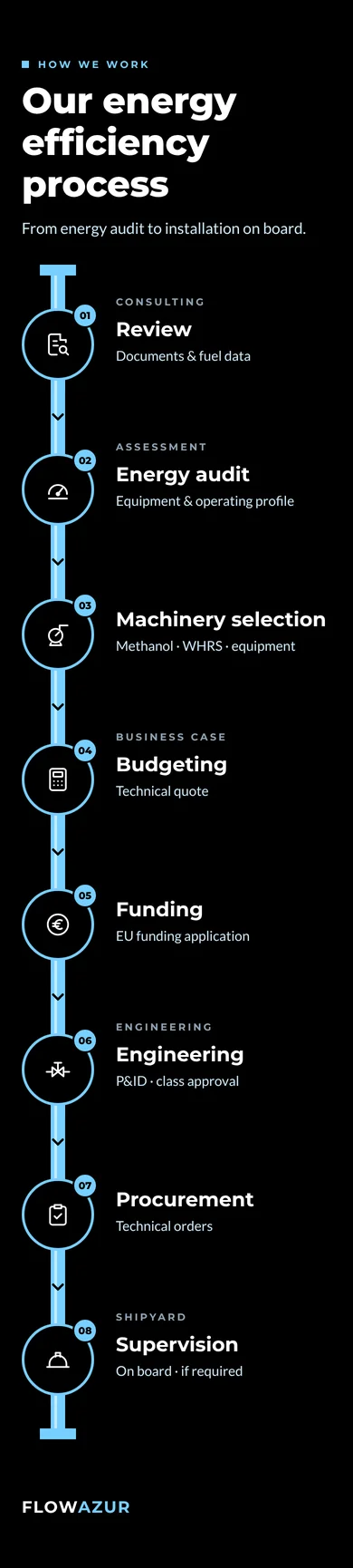
Every project follows the same path. We start from your documents and fuel data, and stay at your side until the new systems are installed on board.
1. Document review and consultation
Our engineering office reviews the vessel’s documentation, routes and fuel data. We then meet you to define the project’s goals, key points and most critical works.
2. Onboard inspection and energy audit
We go on board to survey all the installed equipment, assess the available spaces and take measurements. With the crew, we define the ship’s operating profile and audit its energy consumption.
3. Machinery selection
Whenever the project requires new systems, we propose the most suitable technology and solution on the market, sized on the ship’s real operating profile.
4. Budgeting
We work with your technical manager to define an accurate quote for the new systems and their installation on board.
5. Funding
We prepare all the technical and non-technical documentation for your funding application.
6. Engineering
Our engineering office produces the technical drawings (P&ID, piping installation drawings) to update the vessel’s documentation or to obtain class approval for modifications.
7. Procurement assistance
We assist your technical manager or procurement department with the most technical orders, to make sure no errors are made.
8. Shipyard and onboard supervision (if required)
One of our supervisors follows the installation at the shipyard or on board, backed up by our engineering office.

Why upgrade now
For ships trading in Europe, fuel now costs twice: once at the bunker and once in carbon. Since 2026, EU ETS allowances cover 100% of a ship’s covered emissions, and FuelEU Maritime lowers the GHG intensity limit again in 2030. A ship that burns less pays less on both bills, keeps a better CII rating and holds its value on the secondhand market. Every tonne of fuel you stop burning works for you three times.
Energy efficiency retrofits in Spain, Italy, Malta and France
We work where western Mediterranean ships come for repairs and upgrades. In Spain, from Barcelona to Cádiz. In Italy, from Genoa to Naples and Sicily. In Malta and In France, around Marseille. Our engineers carry out the energy audit on board, wherever the ship trades, and support the shipowner team through engineering, procurement and installation.
Planning an energy efficiency upgrade? Let's review the scope
Share the vessel’s details, the fuel consumption data and the drydock dates. Our engineering office will analyse the documents and contact you to discuss the details of your project.