
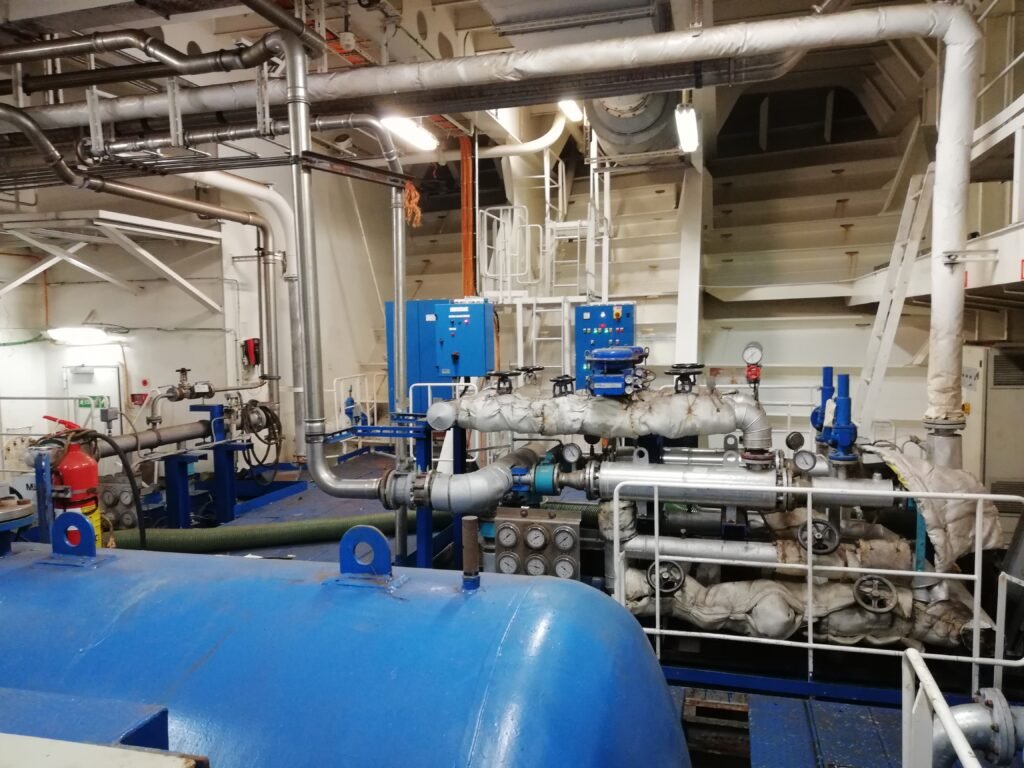
Fresh water is one of the vital services on board any superyacht, cargo ship or cruise vessel. Try to picture life on board without a working tap, a shower or a flushing WC. You can’t.
Yet we take it for granted. Behind every tap sits a potable water system: a network of pipes, fittings, valves, instruments and machinery (pumps, hot water boilers or calorifiers, treatment units), and it needs proper engineering and a disciplined commissioning process.
ISO 15748: the standard behind potable water system design on ships
Hot and cold potable water systems on ships are designed to ISO 15748, a two-part standard. ISO 15748-1:2002 covers planning and design; ISO 15748-2:2002 sets out the method of calculation, from the water quantity carried on board to the size of pressure vessels, heaters and pumps. ISO confirmed Part 1 again in June 2024, so it’s still the current reference.
When we audit a design at Flowazur Consulting, we compare the diagrams and component list from the shipyard (or a third-party engineering firm) against ISO 15748. When we design a system ourselves, we start from the ISO standard and add class and flag requirements, plus what we’ve learnt on board.
So which ISO points should you check to be sure your ship’s system is up to standard?
Check 1: System layout. Hydrophore or pump-driven potable water system?
The first thing we look at is the layout and its main components:
- Is the system hydrophore-driven, with a pressure vessel holding the network under pressure?
- Or is it pump-driven only, with pumps running continuously to keep positive pressure? (We see this on a minority of newbuilds.)
Superyachts between 40 and 65 m usually rely on compact pressure sets: twin pumps, often variable-speed, with a small membrane accumulator. Commercial ships tend to use a classic hydrophore unit, a larger tank with a compressed-air cushion.
Once that’s settled, we move on to the other components: treatment units, valves and the pipework itself.
Check 2: Potable water system components required by ISO 15748-1
Five items carry most of the weight in ISO 15748-1:
✓ Redundant pumps and filters. The standard recommends two or more supply pumps on ships such as passenger vessels; we apply the same logic on yachts. |
✓ A pressure vessel. This can be a hydrophore unit or a small expansion vessel acting as a buffer. |
✓ Non-return valves. ISO wants them downstream of the supply pump, so the pressurised network can’t drain back into the potable water tank when the pump stops. We also check the one on the cold-water feed to the boiler. |
✓ A sterilization unit, such as automatic chlorination or a UV steriliser. |
✓ A manifold with isolation valves for each zone, so the crew can work on one area without shutting down the whole ship, using by-pass pipeline. |
Check 3: Pipe materials for potable water: PB, PP-R or press-fit
On yachts, most systems use one of these:
Polybutene (PB) |
| PP-R, for example aquatherm green pipe |
| Metal press-fit in stainless steel or copper (the costliest option) |
Each one has its own installation procedure and its own typical defects to inspect during assembly: badly fused joints in PP-R, for instance, or fittings left unpressed in a press-fit system.
Two more points before you sign off the material:
The pipe needs class type approval for potable and hot-water service (aquatherm’s PP-R range, for example, holds an ABS type approval that covers potable water and water heating). And every location must meet the fire-endurance matrix of IMO Resolution A.753(18), as amended by MSC.313(88) and MSC.399(95).
Check 4: Pressure loss calculation at every outlet
These systems aren’t demanding to engineer. Pressure losses, though, need a proper analysis; skip it and the upper decks get weak showers, and guests and crew complain.
We model the network in Pipe Flow Expert, a dedicated pressure-loss software. Once the preliminary routing is fixed, it gives us flow rate and pressure at every outlet.
In this way we can resize a branch or a riser, long before anyone complains on board. |
ISO 15748-2 supplies the calculation method behind the demand figures we feed in.
Check 5: Hot water temperature and Legionella prevention
≥ 60 °C hot water leaving the boiler | ≥ 50 °C return water in the circulation loop | 25–50 °C range where Legionella multiplies |
Set the boiler so that hot water leaves it at 60 °C or more. That’s what the WHO Guide to Ship Sanitation (3rd edition, 2011) asks for, together with a circulation loop whose return water never drops below 50 °C.
The reason is Legionella. These bacteria multiply in water between 25 °C and 50 °C; inhaled in shower aerosols, they can cause Legionnaires’ disease, a severe form of pneumonia.
So the loop keeps hot water moving, and hot, all the way to the farthest cabin. To get there, every riser must be balanced, with manual, thermostatic or electronic circulation valves; otherwise the far cabins drift below 50 °C.
At 60 °C, though, water scalds. That’s why the WHO guide asks for thermostatic mixing valves as close to the point of use as possible: the loop stays hot, and the tap delivers a safe temperature to guests and crew. |
Size the boiler with a proper thermal calculation of peak demand, then cross-check it against the guide values in ISO 15748-2, which give heater volume and heating power as a function of the number of people on board.
If your figure and the ISO figure are far apart, find out why.
Cold-water recirculation on superyachts over 70 m
Most ships have no closed loop for cold water. We recommend one for any vessel operating in hot regions, where cold-water lines can sit warm and unused for days.
A typical case: a superyacht with two or more guest cabins left empty for days or weeks. The water in those branches stagnates and warms up towards the temperature of the surrounding spaces
A recirculation line keeps that water moving and cool. On a large yacht in the tropics, we treat it as a safety item
Commissioning a potable water system: 4 issues we keep finding
That movement needs proper expansion compensation: a bending leg at each change of direction, or an expansion loop on long straight runs, with fixed points and sliding points where the installation manual puts them, and shorter support intervals on hot lines. Always check the manufacturer’s installation manual and stay inside its limits.
This one check adds years to the life of the pipework.
H2: Potable water system design and audit: Barcelona, Palma, Valencia, French Riviera, Italy and Malta
On newbuilding projects, Flowazur Consulting stays at your side from concept to commissioning: from our engineering office in Barcelona to shipyards in Palma, Valencia, the French Riviera, Italy and Malta. We apply recognised standards such as ISO 15748, together with class rules and the quality requirements set by each manufacturer.
Designing or auditing a hot and cold water system means cross-checking several key documents, then supervising the work on board. That’s how you cut project risk and avoid costly rework.
Building or refitting a yacht in these areas? Tell us about the project, and we’ll review your hot and cold water system.