APPLICATION FIELD
IACS UR M64, “Design of integrated cargo and ballast systems on tankers,”
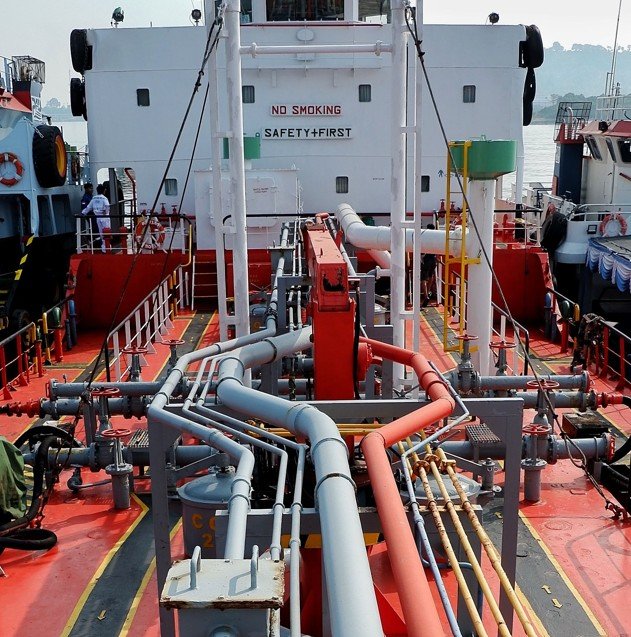
This rule is for tankers where cargo oil pumps, cargo piping, and ballast piping are arranged to share common equipment.
This kind of integrated arrangement typically appears on tankers that aren’t required to carry the full segregated ballast tank (SBT) piping duplication MARPOL Annex I mandates for crude and product carriers.
In particular, it applies to smaller tankers operating under a clean ballast tank (CBT) or crude oil washing (COW) arrangement, where using the same pumps and piping for both cargo and ballast duty, with appropriate safeguards, is permitted rather than requiring a second, fully separate ballast system.
M64 governs the piping design consequences of choosing that integrated arrangement rather than the fully segregated one.
PIPE CLASS / SYSTEM TYPE
M64 doesn’t classify pipes under P2.2. It’s a machinery/system-design UR, not a piping classification rule.
The cargo and ballast piping involved is still classified and constructed under P1/P2 in the ordinary way (cargo oil piping typically Class III, ballast piping typically Class II or III depending on where it runs).
What M64 adds is a system-design layout clarification: because the same physical piping and pump equipment is being asked to carry both cargo oil and ballast water at different times, the rule addresses how that switch-over is achieved without contaminating ballast water with oil residue or vice versa, a concern that has nothing to do with pressure classification and everything to do with system segregation and changeover procedure.
RELATED RULES
- Direct sibling: UR P1/P2 govern the pipe strength, classification and construction of the cargo and ballast piping itself; M64 sits on top of that as a system-arrangement requirement specific to the integrated configuration.
- Statutory backdrop: MARPOL Annex I, particularly the regulations governing segregated ballast tanks and the conditions under which cargo pumps and piping may instead be used for ballast duty (the clean ballast tank framework), is the underlying international instrument that makes an integrated cargo/ballast system a permitted option in the first place for qualifying tankers.
- Cross-reference (as noted by IACS): UR F32, “Fire detecting system for unattended machinery spaces,” is flagged alongside M64, relevant where the pump room serving the integrated system operates unattended.
- Historical cross-reference: IACS’s own listing for M64 also flags E8 and F31 both of which have since been deleted or absorbed into other URs (E8’s content, for instance, was merged into what’s now UR M61 on starting arrangements). Anyone tracing these cross-references today should follow them to their current location rather than treat E8/F31 as live requirements in their own right.
DESCRIPTION
A fully segregated ballast system, the MARPOL default for larger tankers, avoid this problem entirely by never letting cargo oil and ballast water share a pump or a pipe – the two systems simply never touch.
An integrated system gives that separation up, usually for smaller tankers where duplicating the entire pumping and piping plant would raise significant cost and space issues relative to the risk involved, and where MARPOL itself allow the alternative arrangement. But removing physical separation means the safety case shifts entirely onto the changeover procedure and the piping arrangement that supports it a pump or pipe run that carried cargo oil an hour ago has to be verifiably clean before it’s trusted to handle ballast water that may ultimately be discharged to the sea, and the reverse has to hold true as well.
IMPORTANT NOTE
- Given the MARPOL rule, the core consequence of getting an integrated system’s segregation wrong isn’t a piping non-conformity, it’s the possibility of causing pollution during ballasting or de-ballasting – the specific scenario the segregated ballast tank regime was designed to prevent in the first place;
- The historical cross-references to E8 and F31 in IACS’s own listing are a useful reminder that older UR cross-references can go stale as the numbering scheme evolves, worth checking that any cited related requirement is still current before relying on it.
Frequently Asked Questions
Q: What does IACS UR M64 cover?
A: The design of integrated cargo and ballast systems on tankers – cases where cargo oil pumps, cargo piping, and ballast piping share common equipment instead of running fully separate.
Q: Which tankers typically use an integrated cargo/ballast system?
A: Usually smaller tankers operating under a clean ballast tank (CBT) or crude oil washing (COW) arrangement, where MARPOL Annex I allows shared pumps and piping instead of full segregated ballast tank duplication.
Q: Does M64 classify the piping itself?
A: No. Cargo and ballast piping is still classified and built under P1/P2 as usual — M64 governs the system arrangement and the changeover procedure between cargo and ballast duty.
Q: What’s the main risk M64 addresses?
A: Contamination – cargo oil residue getting into ballast water that may be discharged to sea, or the reverse. The rule governs how the changeover is achieved without that happening.
“Flowazur is not affiliated with, endorsed by, or sponsored by ISO, ASTM, ASME or API. All standard names and numbers are property of their respective organizations.”
Expert Marine and Piping Engineers at Your Side
Piping systems often go unnoticed until they cause major problems and major rework follows. Avoid uncertainty, reduce project risk, and keep your schedule on track with Flowazur Consulting.
Our team includes highly experienced, specialized:
- Piping Consultors
- Marine system engineers
- Piping System Engineer
- Technical Managers