APPLICATION FIELD
IACS UR F16, “Bow and stern loading and unloading arrangements on oil tankers,”
It applies to tankers with a piping arrangement for cargo transfer located at the bow or stern rather than the conventional midships manifold.
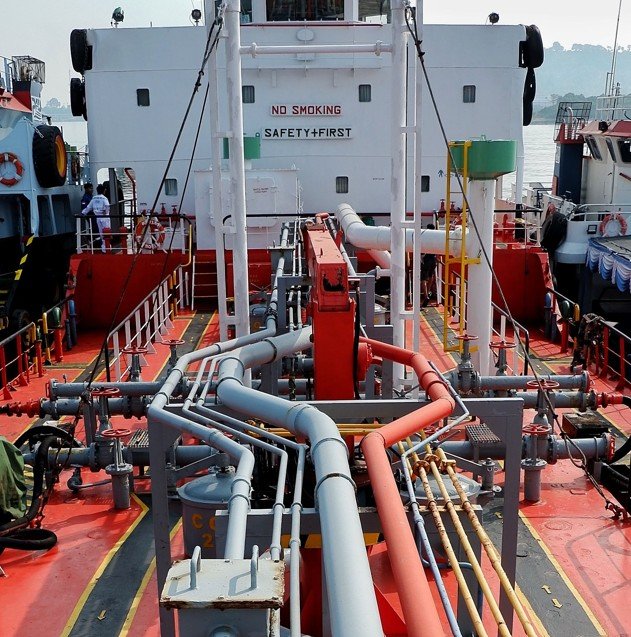
F16 governs the piping and arrangement consequences of that configuration: because the cargo transfer line now has to run the length of the exposed deck from the bow or stern connection point back to the cargo system, F16 governs the piping and arrangement consequences of that configuration. Because the cargo transfer line now has to run the length of the exposed deck from the bow or stern connection point back to the cargo system, it creates a piping route and hazard profile different from the midships manifold arrangement the rest of the piping rules generally assume.
PIPE CLASS / SYSTEM TYPE
F16 doesn’t classify pipes under P2.2. The bow or stern loading line itself is still cargo oil piping – ordinarily Class III – classified and constructed under P1/P2 in the usual way.
What F16 governs is the arrangement, routing and protection of that specific pipeline, given how unusual its geometry is compared to a standard cargo system: it runs the full length of the exposed deck rather than staying confined to the cargo area amidships, which changes both its exposure to mechanical damage and the extent of hazardous atmosphere it generates at its working end.
RELATED RULES
- Direct sibling: UR F15, “Reinforced thickness of ballast and cargo oil piping,” iis directly relevant here: a cargo line running the full exposed length of the deck to reach a bow or stern connection point is precisely the kind of routing that calls for the reinforced wall thickness treatment F15 addresses, rather than the standard Table 3 minimums alone.
- Statutory backdrop: The IBC Code, paragraphs 3.7.7 and 3.7.8, supplies the hazardous-area treatment that F16 draws on for bow and stern loading connections, a case where the oil tanker rule leans on a chemical tanker code provision because the IBC Code addressed this specific remote-connection scenario first and in more technical depth; the guidance is explicit that paragraph 3.7.8 applies only to stern or bow loading arrangements.
- Statutory backdrop: SOLAS II-2/4.5.2.2 governs the positioning of openings to main cargo control stations and service spaces relative to hazardous sources, relevant wherever a bow or stern loading point sits close to accommodation or control spaces.
- Cross-reference: IEC 60092-502:1999 supplies the hazardous area classification and electrical equipment standard referenced for the zone extents around the bow/stern connection.
- Cross-reference: UR F26, “Safety aspects of double bottoms and duct keels,” is relevant in practice since the long cargo transfer line to a bow or stern connection is often routed through a protected duct keel or trunk running much of the ship’s length.
RESTRICTION
The clearest verified restriction concerns hazardous zone extent at the bow or stern connection itself: the area within the coaming, or within 3 metres beyond the shore/buoy connection or potential spillage point, up to a height of 2.4 metres above the deck, is classified as Zone 1, with a further 1.5 metres beyond that classified as Zone 2. This specific distance set applies to bow and stern loading arrangements. Beyond that, the practical restriction that follows from F16’s connection to F15 is that the extended, exposed routing of the bow/stern cargo line calls for reinforced piping treatment rather than standard minimum wall thickness, given the greater length exposed to weather and mechanical damage risk compared to a conventional cargo system confined to the midships cargo area.
DESCRIPTION
Bow and stern loading arrangements exist to give a tanker operational flexibility that a fixed midships manifold doesn’t: connecting to an offshore terminal, a single-point mooring buoy, or another vessel during a lightering operation; That flexibility comes at a structural and safety cost, though, because it means running a live cargo oil line the full length of the exposed weather deck rather than keeping cargo transfer confined to the compact, well-understood hazardous area around a midships manifold.
A pipe that long, running across open deck from bow or stern back to the cargo system, is more exposed to weather, vibration, and potential mechanical damage than the ordinary cargo piping the ship’s other rules were written around. At the same time, the connection point itself, wherever a hose or hard-arm from an offshore terminal actually joins the ship’s piping, creates its own localized hazardous atmosphere, and because this scenario doesn’t map onto the standard midships manifold hazardous-area treatment already established for oil tankers, F16 borrows the more detailed requirements the IBC Code had already worked out for the analogous situation on chemical tankers.
IMPORTANT NOTE
- The hazardous zone extents confirmed here (3 metres to 2.4 metres height for Zone 1, an additional 1.5 metres for Zone 2) apply specifically to bow and stern loading
- Given the unusually long exposed run of a bow or stern cargo line, treating it as ordinary Class III cargo piping without applying F15’s reinforced thickness consideration is a design mistake worth checking
Frequently Asked Questions
Q: What does IACS UR F16 cover?
A: The piping, arrangement, and routing requirements for oil tankers that load or unload cargo at a bow or stern connection instead of the standard midships manifold.
Q: Is bow or stern loading piping classified differently from standard cargo piping?
A: No. It’s still cargo oil piping, ordinarily Class III, built under P1/P2 in the usual way. F16 governs the arrangement and routing, not the pipe class itself.
Q: How large is the hazardous zone around a bow or stern loading connection?
A: Zone 1 covers the area within the coaming, or within 3 metres of the connection or spillage point, up to 2.4 metres above deck. Zone 2 adds a further 1.5 metres beyond that.
Q: Does the long exposed piping run need extra wall thickness?
A: Yes. UR F15’s reinforced thickness applies, given the greater exposure to weather and mechanical damage compared to a standard midships cargo line.
“Flowazur is not affiliated with, endorsed by, or sponsored by ISO, ASTM, ASME or API. All standard names and numbers are property of their respective organizations.”
Expert Marine and Piping Engineers at Your Side
Piping systems often go unnoticed until they cause major problems and major rework follows. Avoid uncertainty, reduce project risk, and keep your schedule on track with Flowazur Consulting.
Our team includes highly experienced, specialized:
- Piping Consultors
- Marine system engineers
- Piping System Engineer
- Technical Managers