
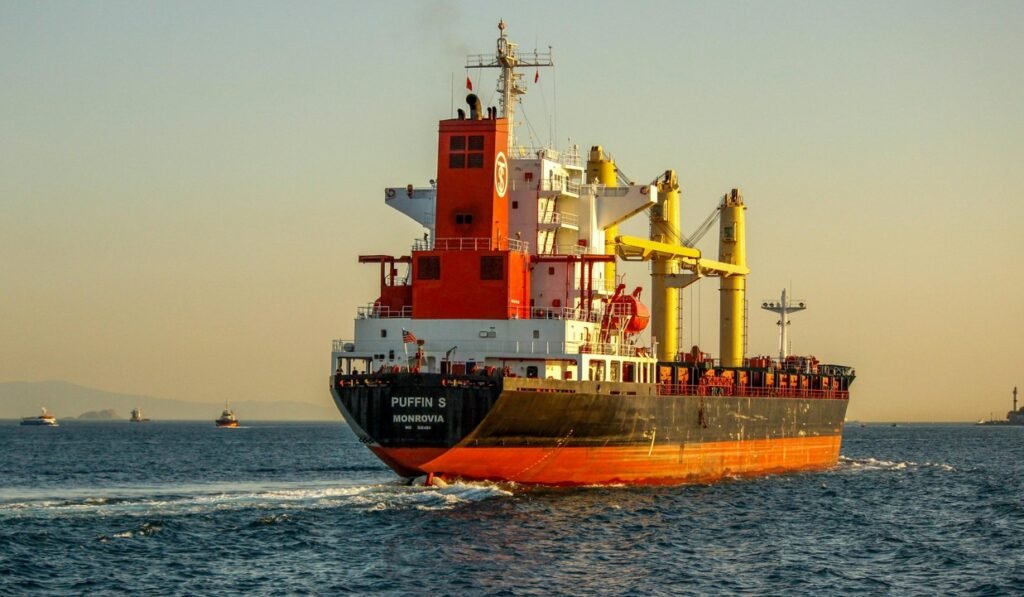
Integrating methanol into an existing ship in operation, or into a new modern newbuild, introduces safety challenges that go well beyond a standard fuel-system retrofit.
Unlike conventional marine gas oil (MGO), methanol has a low flashpoint (11–12°C), which means it generates flammable and explosive vapours even at ambient temperature.
It carries severe neurotoxic hazards on contact or inhalation, and it burns with a flame that is essentially invisible in daylight.
- Flammable/explosive vapours at ambient temperature
- Neurotoxic effects upon inhalation
- Irritation on skin contact
- Severe injury risk on direct eye contact
- Flames invisible in daylight
We’re not talking about a theoretical list here. Each of these hazards translates into a real operational problem: an undetected leak, an unprotected worker, a fire nobody sees until it’s too late.
And this is exactly why classification societies and flag administrations don’t treat a methanol conversion like any other piping modification.
If the safety case isn’t built properly from day one, the consequence isn’t a paperwork delay, it’s a design that gets sent back, a construction schedule that slips, or worse, an incident on deck during bunkering or maintenance.
Transitioning to methanol cannot be treated as a standard piping modification. It requires a formal, systematic safety assessment before final design approval: the Hazard Identification (HAZID) study.
Quick Facts
- Methanol has a flashpoint of just 11–12°C, so it produces flammable vapour even at normal ambient temperature.
- The IGF Code’s prescriptive rules cover only LNG; methanol and ethanol fuel systems are governed by the IMO’s MSC.1/Circ.1621, adopted in November 2020.
- A methanol HAZID assesses four critical system nodes: the Bunker Station, Storage Tanks & Venting, the Fuel Treatment Room, and the Fuel Supply Line & Engine Interface.
- Classification societies will not grant statutory approval for a methanol fuel system design without a completed HAZID report.
- A thorough methanol HAZID report typically runs 30 to 50 pages.
The Regulatory Mandate: Why HAZID is Required
The IMO’s IGF Code (International Code of Safety for Ships Using Gases or Other Low-flashpoint Fuels) sets out the general safety philosophy for low-flashpoint fuels, but its detailed prescriptive provisions in Part A-1 are currently limited to natural gas (LNG). For methanol and ethanol, the applicable technical instrument is the Interim Guidelines for the Safety of Ships Using Methyl/Ethyl Alcohol as Fuel (MSC.1/Circ.1621), adopted by the IMO Maritime Safety Committee in November 2020.
These Guidelines extend the IGF Code’s general framework, including the risk assessment requirement under section 4.2 to methanol/ethanol-fuelled ships, and classification societies (DNV, Bureau Veritas, Lloyd’s Register, RINA, ClassNK, CCS, among others) have incorporated them directly into their own rule sets.
In practice, we should think of it as a two-layer framework: the IGF Code Part A gives the goal-based structure and the general requirements, and MSC.1/Circ.1621 fills in the fuel-specific technical detail for methanol and ethanol.
Under this framework, any vessel utilizing a low-flashpoint fuel must undergo a detailed risk assessment addressing risks to persons on board, the environment, and the structural strength or integrity of the ship. Classification societies and flag administrations will not grant statutory approval to basic or detailed design arrangements without a completed HAZID report.
A risk assessment should be conducted to ensure that risks arising from the use of methyl/ethyl alcohol fuels affecting persons on board, the environment, the structural strength, or the integrity of the ship are addressed
IMO - IGF Code For Using Methyl/Ethyl Alchol As Fuel IMO_IGF Code
The HAZID workshop acts as a regulatory gatekeeper. Its purpose is to:
Prove that the risks introduced by the alternative fuel are mitigated to an As Low As Reasonably Practicable (ALARP) level compared to a conventional oil-fuelled ship.
Validate the layout of hazardous zones, ventilation systems, and emergency escape routes.
Identify potential single points of failure in piping networks, inert gas systems, and automation logic before physical components are ordered or installed.
The Analysis Methodology: How a Methanol HAZID is Conducted
A HAZID study relies on a structured, qualitative brainstorming process led by an independent chairperson and executed by a multidisciplinary team of marine engineers, naval architects, system suppliers, and vessel operators.
The process breaks the ship’s fuel infrastructure down into discrete functional blocks, known as Nodes. For each node, the team applies specific Guide Words to identify potential deviations from the intended design intent, determine the underlying causes, and evaluate the safety or operational consequence.
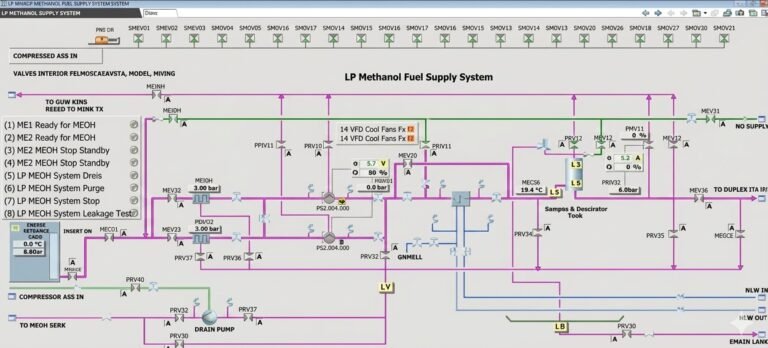
Source: CM Energy
The 4 Critical Methanol System Nodes
Considering a methanol system onboard, we have 4 main nodes to analyze.
Node 1: Bunker Station & Transfer Lines: Covers the manifold connections, emergency release couplings (ERC), spill trays, and vapour return lines on the open deck.
Node 2: Storage Tanks & Venting Systems: Focuses on the hull or structural fuel tanks, nitrogen (N2) blanketing lines, pressure/vacuum (PV) valves, and the mast vent arrangement.
Node 3: Fuel Treatment Room (FTR): Evaluates the enclosed machinery space housing the low-pressure fuel preparation skids, filtration units, and heat exchangers.
Node 4: Fuel Supply Line & Engine Interface: Follows the double-walled piping network, the Fuel Valve Train (FVT), and the high-pressure injection rails on the dual-fuel main engine.
Practical Analysis Examples and Guide Word Applications
To illustrate how this methodology functions during a workshop, consider the following specific risk scenarios analyzed across the core system nodes:
Example A: Applying “External Leak / Spill” to Node 1 (Bunker Station)
Deviation: A flanged pipe joint failure or gasket rupture at the bunker manifold during fuel transfer.
Methanol Specific Hazard: Methanol vapour is heavier than air (relative vapour density around 1.1), so it settles along structural coamings on deck rather than dispersing upward, creating an immediate fire hazard at floor level.
Analysis & Consequences: Liquid methanol accumulates on the open deck. If it contacts non-Ex rated electrical gear, it can ignite and generate flames that are invisible in daylight, putting crew and terminal operators at risk without any obvious warning sign.
Engineering Safeguards: Installation of a dedicated stainless-steel coaming/drip tray with a gravity drain leading directly to a dedicated slop tank. Integration of optical flame detectors (which pick up infrared/ultraviolet spectrums invisible to the human eye) paired with an automated alcohol-resistant water spray system to fight methanol flames.
Example B: Applying “Loss of Blanketing / Inerting Pressure Deviation” to Node 2 (Storage Tanks)
Deviation: Loss of nitrogen (N2) blanket pressure in the tank ullage space.
Methanol Specific Hazard: Unlike diesel, methanol’s flashpoint sits well below normal operating temperatures. Without an inert gas blanket, the free space inside the tank fills quickly with methanol vapour, which has a flammable range of roughly 6.0% to 36% by volume in air.
Analysis & Consequences: Air enters the tank through the vacuum valve as fuel is consumed. The tank atmosphere becomes highly explosive within a short time.
Engineering Safeguards: Redundant (2 x 100%) nitrogen generation systems with automated pressure-monitoring loops. If tank pressure drops below the critical low-pressure setpoint defined for the specific installation, typically in the tens of millibar range below atmospheric, consistent with the vacuum-relief-valve settings required by class rules; the system triggers an emergency low-pressure alarm, trips the fuel pumps, and automatically switches to a backup nitrogen bottle.
Example C: Applying “Toxic Release” to Node 3 (Fuel Treatment Room)
Deviation: Pinhole leak or gasket failure on a low-pressure pump flange inside the enclosed FTR.
Methanol Specific Hazard: A leaking flanged joint generates methanol vapour. Methanol vapour is toxic, and the occupational exposure limit (OEL) is highly restrictive, typically set at a time-weighted average of 200 ppm.
Analysis & Consequences: Liquid methanol accumulates inside the machinery skid. Vapour concentration rises in the enclosed space, risking crew poisoning during routine maintenance rounds.
Engineering Safeguards: Enclosing the FTR with a mandatory negative-pressure ventilation system achieving at least 30 air changes per hour (ACH), in line with class requirements for fuel preparation rooms. Installation of electrochemical gas detectors positioned at low level (methanol vapour is heavier than air when cold) set to trigger an engine room alarm and isolate the space at 10% of the Lower Flammable Limit (LFL) or above the toxic threshold, whichever comes first.
Example D: Applying “High Pressure / Loss of Containment” to Node 4 (Fuel Supply Line & Engine Interface)
Deviation: Failure of the inner pipe wall in the double-walled fuel supply line between the Fuel Treatment Room and the engine, with the annular space still intact.
Methanol Specific Hazard: Because the primary containment fails without any external sign, methanol can accumulate silently in the annular space of the double-walled piping.
Analysis & Consequences: If the annular-space ventilation or leak detection fails to recognize up the ingress, methanol vapour can reach the engine room atmosphere through the ventilation trunk, creating a toxic and flammable hazard far from the original leak point.
Engineering Safeguards: Continuous under-pressure mechanical ventilation of the annular space (with a minimum air-change capacity consistent with class requirements), dedicated leak detection in the annulus, and a Fuel Valve Train configured as a double block-and-bleed arrangement so the fuel supply can be isolated and vented to a safe location automatically on an ESD signal.
The Importance of Solid Engineering Knowledge
Only expert marine engineers and piping engineers can lead efficiently an HAZID for methanol fuel systems. The reason behind it appear simple to understand once analyzed the example proposed above. An in deep knowledge of the overall methanol system is required in order to analyze nodes and other single parts. HAZID studies don’t consist of only few pages, but it’s true the opposite.
Generally a well-executed HAZID for methyl alchol as fuel require an exstensive study and brainstorming process leading to a written official document of 30 or 50 pages.
Alternative Design and Arrangements (AD&A) process governed by SOLAS Chapter II-1, Regulation 55 require an equivalent level of safety for methanol fuel system
Such “equivalent level” can be reached only by an in-depth HAZID where all the methanol systems hazard are identificated and the risk mitigated with engineering strategies or sensors/detectors.
Engineering teams not experienced with methanol fuel systems can easily overlook some – or many – parts of the system and its related auxiliary equipment.
As a consequence, one or more mitigation measures end up missing, resulting in an in-depth engineering review and mitigation-component integration, plus a full review of the HAZID itself.
As consequence one or more mitigation systems are absent resulting in-depth engineering systems review and mitigation part integration, PLUS a review of the overall HAZID
At Flowazur Consulting, we carry out a preliminary HAZID already during our Feasibility Study service, and then develop the official HAZID report for class during the basic engineering phase.
For a solid engineering design and a smoother class approval process
Book a consultation with one of ours engineers to discuss in detail your project
Frequently Asked Questions
Q: What is a HAZID study for methanol-fuelled ships?
A: A structured hazard identification workshop that assesses fire, toxicity, and containment risks across the ship’s methanol fuel system before final design approval.
Q: Which IMO regulation applies to methanol as a marine fuel?
A: The Interim Guidelines MSC.1/Circ.1621, adopted by the IMO in November 2020, since the IGF Code’s Part A-1 prescriptive rules currently cover only LNG.
Q: What are the main safety hazards of methanol as a marine fuel?
A: Flammable vapour at ambient temperature, neurotoxic effects on contact or inhalation, and flames that are invisible in daylight.
Q: What system nodes does a methanol HAZID analyze?
A: Four nodes: the Bunker Station & Transfer Lines, Storage Tanks & Venting Systems, the Fuel Treatment Room, and the Fuel Supply Line & Engine Interface.
Q: How long is a typical methanol HAZID report?
A: A well-executed HAZID report generally runs 30 to 50 pages.
Q: Who can lead a methanol HAZID workshop?
A: Only marine and piping engineers with in-depth knowledge of methanol fuel systems, since less experienced teams tend to overlook critical hazards or mitigation measures.