
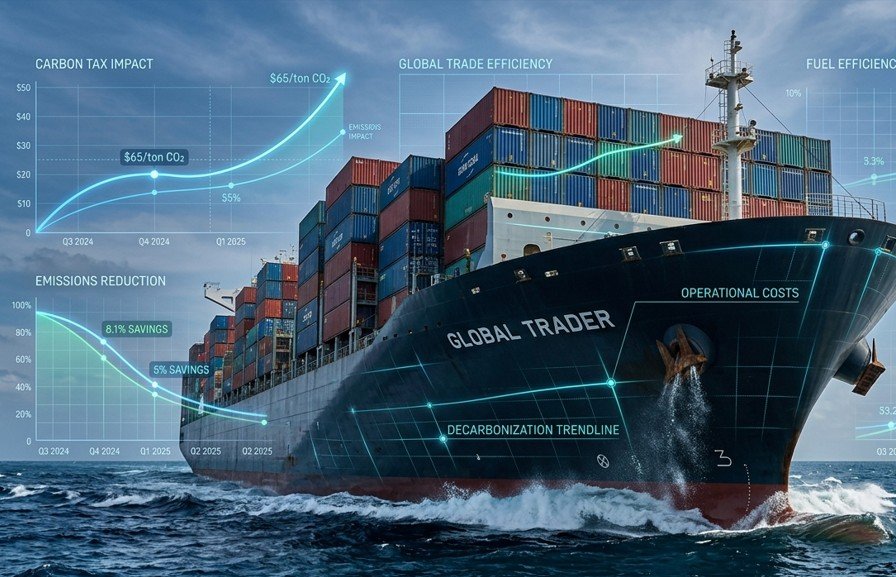
International Maritime Organization (IMO) and EU regulations have fundamentally rewritten the financial metrics of fleet operations.
With the EU Emissions Trading System (ETS) and FuelEU Maritime enforcing greenhouse gas (GHG) reductions, shipowners can no longer evaluate only the return on investment (ROI) of a green retrofit project in isolation.
They need to shift to a wider view one that looks at the fleet as a single regulatory unit rather than a “group of individually optimized vessels”.
Under these frameworks, particularly the compliance mechanics of FuelEU Maritime, a retrofitted vessel is no longer just a single green asset. It becomes a powerful regulatory leverage tool.
By converting just one vessel in a fleet to dual-fuel methanol, a shipowner can generate a substantial compliance surplus.
Through regulatory mechanisms specific to FuelEU Maritime, this surplus can be used to amortize the carbon liabilities and financial penalties of multiple conventional sister ships in the same fleet.
Quick Facts
- The EU ETS has no legal pooling mechanism; each ship’s emissions and EUA cost stand alone.
- FuelEU Maritime (Article 21) allows a real pooling system; surplus from one compliant ship can offset deficits of others.
- A single methanol retrofit can generate enough compliance surplus to cover several conventional sister ships.
- VLSFO already sits above the 2025 FuelEU limit, while green methanol can cut GHG intensity to around 10 gCO2eq/MJ.
- A feasibility study with financial evaluation is essential before committing to a retrofit project.
ETS Allocations and The FuelEU Pooling System
To understand how a single methanol-retrofitted vessel can financially balance an entire fleet, we first need to distinguish between the two primary EU maritime regulations and how each one handles fleet dynamics, because they don’t work the same way, and confusing them is where most compliance strategies go wrong.
The EU ETS: Individual Accountability (With Commercial Offsets)
The EU ETS is a cap-and-trade carbon pricing scheme. Every vessel above 5,000 GT calling at EU ports must monitor and report its actual carbon emissions via the Monitoring, Reporting, and Verification (MRV) system. For every tonne of CO2 equivalent emitted, the shipping company must pay one European Union Allowance (EUA).
An EUA represents the legal right to emit exactly one tonne of carbon dioxide equivalent.
Speaking directly: there is no formal “pooling system” within the EU ETS legislation that lets you average out raw emissions data across a fleet.
If Ship A burns heavy fuel oil, it owes EUAs for every tonne emitted, regardless of what Ship B does, each ship’s monitored emissions stand on their own.
What a fleet operator can do is manage this financially at the corporate level.
The radical reduction in emissions from a methanol-fuelled vessel (Ship B) means the company avoids purchasing a large volume of EUAs.
Those avoided costs, corporate capital in effect ,can then be reallocated internally to cover the EUA expenditure of the conventional vessels (Ships A, C, and D) in the fleet. It’s an accounting offset, not a regulatory one.
FuelEU Maritime: The True “Pooling System”
While the ETS targets total absolute emissions, FuelEU Maritime regulates the greenhouse gas intensity of the energy used onboard, measured in grams of CO2 equivalent per megajoule [gCO2eq/MJ].
The limit is set against a 2020 fleet-average baseline of 91.16 gCO2eq/MJ, and it tightens progressively over time, starting at -2% in 2025, reaching –6% by 2030, and climbing to -80% by 2050 (with intermediate steps along the way).
If a vessel’s fuel mix has a GHG intensity higher than the mandated limit for that year, it is non-compliant, and a direct financial penalty, calculated per megajoule of non-compliant energy, referenced against a rate of EUR 2,400 per tonne of VLSFO-equivalent , is applied to the shipowner.
Conversely, if a vessel burns a fuel that is low-carbon under the regulation, green methanol or bio-methanol, for instance it operates with a lower GHG intensity than required, generating a Compliance Surplus.
FuelEU Maritime explicitly allows for a Pooling System.
Under Article 21 of the regulation, companies can pool the compliance balances of multiple ships.
The compliance surplus of one highly efficient, methanol-fuelled vessel can be legally transferred, within the FuelEU database, to offset the compliance deficits of several conventional vessels in the same pool; with one important constraint worth keeping in mind:
under Article 21(4), the pool’s total balance must remain positive after allocation, and no ship can be worse off (a surplus ship cannot end up in deficit, a deficit ship cannot end up with a bigger one). In practice, this means the surplus vessel needs to generate “enough financial volume” to cover the others with margin, not just break even on paper.
One Retrofit Saving Four Sister Ships
To see the scale of what pooling can do, consider the following example.
A small fleet of five identical 50,000 DWT Handymax product tankers operating on European routes.
Fleet exposure to the new regulations.
The problem: all five vessels run on conventional Very Low Sulphur Fuel Oil (VLSFO). VLSFO’s default well-to-wake GHG intensity, per the Annex II factors used under FuelEU Maritime, sits close to the 2020 fleet-average baseline itself, around 91–92 gCO2eq/MJ.
That means a VLSFO-only fleet is already above the 2025 compliance limit of 89.34 gCO2eq/MJ on day one, before the schedule has even started to bite. This is a detail worth being precise about: 89.3 gCO2eq/MJ is not what VLSFO emits.
The Result:
As the FuelEU limit tightens toward 2030, each of these conventional vessels must pay an annual non-compliance penalty tied to its deficit, calculated against the EUR 2,400/tonne VLSFO-equivalent reference rate. For five ships, the cumulative annual FuelEU exposure adds up quickly in direct cash outlays to the administering authority, on top of the fleet’s separate EU ETS carbon costs.
What Happens With One Green-Methanol Retrofit
Instead of executing a capital-intensive, high-risk green retrofit across all five vessels, which would tie up the fleet’s operational capacity for an extended period, the shipowner can retrofit just one vessel to run on sustainable green methanol.
Green methanol or e-methanol carries a very low well-to-wake GHG intensity, frequently calculated in the low single digits to around 10 gCO2eq/MJ depending on the production energy mix, against VLSFO’s ~91-92.
On top of that, under FuelEU Maritime, using RFNBOs (Renewable Fuels of Non-Biological Origin) triggers a reward multiplier that doubles the counted energy content of those fuels for compliance purposes, but only until 31 December 2033, a deadline worth to be mentioned for anyone modelling this over a longer horizon.
The Pooling Equilibrium
Because the calculation is volumetric and intensity-based, the math works out in positive for fleet owners:
Compliance Balance = (Target Intensity – Actual Fuel Intensity) × Total Energy Consumed
The single retrofitted vessel, running on e-methanol, generates a large compliance surplus.
Brought into a formalised FuelEU compliance pool with its four conventional sister ships under Article 21, this one asset’s surplus can neutralise the deficits of the other four, provided the surplus is large enough to keep the pool’s net balance positive after allocation, as the regulation requires.
Done correctly, the five-ship fleet reaches regulatory compliance as a group, reducing the fleet’s external FuelEU financial penalties to zero, without having to convert every ship in the fleet.
The importance of the numbers
Converting a ship running on conventional fuels to a dual-fuel ship is not an easy operation and requires many tasks such as: risk assessment, engineering drawings, a lengthy approval framework to certify the “safety equivalence,” a shipyard able to understand the philosophy of the methanol system to reduce assembly risks.
Although methanol retrofit projects can be challenging, they represent one of the best solutions to stay in compliance and avoid overpaying carbon tax penalties.
For this reason, a feasibility study that includes a full financial evaluation of the converted ship is mandatory before proceeding with any kind of project signature.
At Flowazur Consulting, our feasibility study assesses all operative profiles of the existing ship and identifies technical solutions to convert it to dual-fuel. We design the methanol system and its integration onboard. Finally, we calculate the carbon tax savings and the project ROI, factoring in the FuelEU pooling system
We handle the technical part to assess the feasibility of the project and its financial result.
Book a call with one of our engineers to discuss your project in detail
Frequently Asked Questions
Q: What is the difference between EU ETS and FuelEU Maritime pooling?
A: The EU ETS has no formal pooling mechanism; FuelEU Maritime does, under Article 21.
Q: Can one retrofitted ship offset the emissions of an entire fleet?
A: Yes. A single methanol-fuelled vessel can generate enough compliance surplus to cover several conventional sister ships in a FuelEU pool.
Q: What GHG intensity limit applies under FuelEU Maritime in 2025?
A: 89.34 gCO2eq/MJ, tightening to -6% by 2030 and -80% by 2050.
Q: What happens if a vessel’s fuel intensity exceeds the FuelEU limit?
A: The shipowner pays a penalty referenced against EUR 2,400 per tonne of VLSFO-equivalent non-compliant energy.
Q: Is there a limit to how much surplus can be pooled?
A: Yes. Under Article 21(4), the pool’s total balance must stay positive, and no ship can end up worse off after allocation.