
In a methanol-fuelled vessel, the methanol fuel system is composed of numerous skids, lines, and branches, configured according to the specific vessel.
However, certain elements are always present onboard and are typical of this type of marine system.
Due to methanol’s characteristics:
- Low flashpoint
- Toxicity
- LEL 6.0% – UEL approx. 36% (values vary slightly, 36–36.5%, depending on the reference source)
the methanol fuel system must incorporate special safety devices and arrangements to continuously mitigate risk onboard, particularly to protect safe areas where no other, or less stringent, mitigation systems are installed.
We have seen firsthand, during inspections and refitting projects, what happens when this isolation philosophy is treated as a checkbox rather than a working system: a single leaking seat on a block valve is enough to bring methanol vapour into a space that was never designed to handle it.
That is the real cost of getting isolation wrong, and it’s why double block and bleed (DBB) valves are not an optional refinement.
To this end, international regulations require Double Block and Bleed valves in specific, well-defined points of the fuel system. Far from being a simple pair of standard valves, a DBB arrangement is a dynamic fluid-containment piping system designed to guarantee total isolation under both normal operating conditions and during Emergency Shutdown (ESD) trips.
Quick Facts
– A DBB arrangement uses two block valves in series plus a bleed valve that drains the trapped cavity between them.
– MSC.1/Circ.1621 paragraph 6.4.4 requires DBB valves on the inert gas supply line, not the main fuel line to the engine.
– Class societies extend the same DBB isolation logic to the fuel train to the machinery space through design equivalence.
– A single DBB valve typically costs $2,000–$3,500 and has longer lead times than standard valves.
– DBB systems come in two configurations: a split-valve manifold of three separate valves, or a single integral dual-seat valve.
The IGF Code & Class requirement for a total isolation.
The regulatory picture behind DBB on methanol-fuelled ships is more layered than it might look at first glance, and it’s worth being precise about where each requirement actually sits.
- IMO IGF Code (Resolution MSC.391(95)): establishes the baseline goal-based philosophy for low-flashpoint fuel isolation. The Code’s own definition of a double block and bleed valve, two valves in series with a third valve enabling pressure release: it is the reference definition used across the industry, including by class societies when they extend the concept to methanol systems.
- IMO MSC.1/Circ.1621 (paragraph 6.4.4): this is where the DBB requirement is explicitly written into the methanol/ethanol guidelines, and it applies to the inert gas supply line, not the fuel line to the engine. The provision exists to prevent flammable liquid or vapour from migrating back into the inert gas system and, from there, into gas-safe spaces: two shut-off valves in series with a venting valve in between, plus a closable non-return valve installed between the DBB arrangement and the fuel system, located inside hazardous spaces.
- Fuel supply to consumers (Section 9 of MSC.1/Circ.1621): here the guidelines require an automatically operated master fuel valve outside the machinery space (9.6.3), a remotely operated shut-off valve at each consumer (9.6.5), a manually operated shutdown valve for maintenance (9.6.6), and mandate that all these valves be of the fail-safe type (9.6.7). The text does not use the term “double block and bleed” for this particular train; the isolation concept, though, is the same one class societies apply by design equivalence under the alternative design provisions of the guidelines, extending the architecture that the IGF Code already mandates explicitly for gaseous low-flashpoint fuels.
- Class Society Requirements (e.g. DNV, Lloyd’s Register): in practice, this is where the DBB philosophy for the methanol fuel train to the machinery space gets formalised into a verifiable design requirement: fast-acting, fail-closed block valves and a fail-open bleed valve, integrated into the ship’s independent ESD automation. DNV’s “LFL fuelled” class notation is a concrete example of how a goal-based guideline gets translated into prescriptive, auditable rules.
So when we talk about DBB “on the fuel train,” we’re really talking about an engineering solution that class societies apply consistently across the fuel supply system; Inert gas line included by explicit IMO text, consumer fuel line included by class practice and design equivalence, rather than a single line item you can point to in one paragraph of one circular.
Working Principle and Fluid Dynamics
The primary goal of double block and bleed valves is to ensure that if the upstream block valve suffers a seal failure, the leaking fluid is intercepted and safely drained before it can pass the downstream block valve.
The Two Configurations
In marine piping engineering, DBB can be achieved via two distinct methodologies:
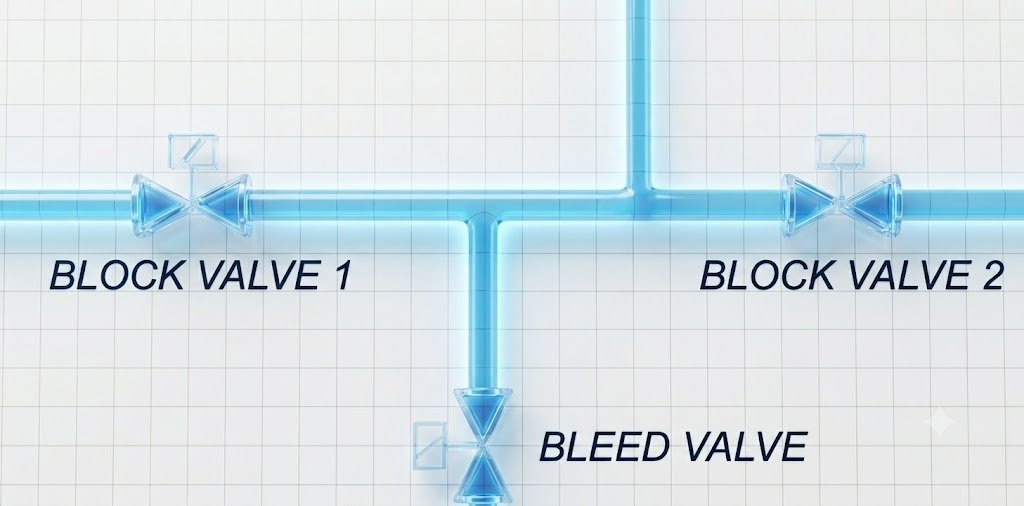
- Split-Valve Manifold: two physically independent, class-certified automated valves (Block 1 and Block 2) are installed in series within the pipeline, with a third, smaller automated valve (Bleed) branched on the spool piece between the two block valves.
- Integral Dual-Seat DBB Valve: a single, specialized valve body containing two independent seating surfaces (typically ball or gate mechanisms) with an internal cavity bleed port located between them.
We tend to see the “split-valve manifold” on larger bore lines and the integral valve on tighter skids where space is a challening matter on the piping layout; both are accepted solutions, and the choice usually comes down to yard preference and available deck space more than anything else.
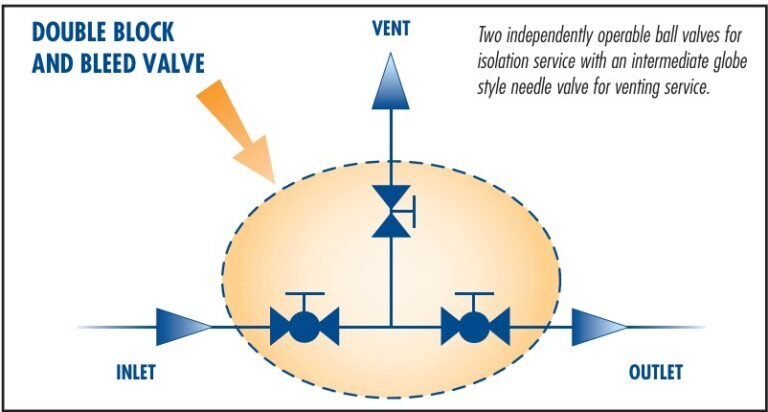
Photo Taken from: Bonney Forge
Fluid-Dynamics of the Bleed valve
When both block valves close during an isolation event, liquid methanol becomes trapped within the internal cavity or spool piece. If the upstream valve leaks due to seat erosion or a damaged seal, the fluid enters this intermediate zone.
The bleed valve, which is normally open when the system is shutdown, drains the trapped fluid directly to a dedicated methanol slop/drain tank. Because the bleed line drains to the tank and not toward any pressurized pipeline or component, the intermediate cavity pressure P_cavity drops immediately to near 0 bar.
This working principle generates a pressure gradient where the downstream block valve experiences essentially zero differential pressure across its seat (P_downstream – P_cavity ≈ 0). Without a differential pressure (ΔP ≈ 0), fluid cannot migrate past the second seal into the engine room, effectively eliminating the risk of leakage and methanol vapour accumulation.
Automated Purge Sequencing and Transient Pressures
Because of the hazards inherent to methanol, the DBB system is a fundamental piping component of the fuel system, guaranteeing total isolation during an emergency event. To reach that goal, double block and bleed valves must execute a precise automation sequence once an ESD has been triggered. An incorrect or not properly executed sequenced valve train can lead to severe hydraulic anomalies and, in the worst case, to leakage.
Normal Shutdown and ESD Sequencing
When the system receives a shutdown signal — whether a normal operational stop or an emergency ESD — the valves must execute a programmed sequence to prevent pressure spikes and ensure safe isolation:
- Simultaneous Block Closure: the pneumatic or hydraulic actuators trigger the rapid closure of Block Valve 1 and Block Valve 2. Fast-acting fail-safe actuators are standard practice on this application — typical closure times for compact ESD actuators on this valve size range fall within a few seconds — the goal being to cut the flow rate as fast as practicable and limit the presence of methanol in any at-risk zone.
- The Transient Delay (t₁): a short programmed delay is built into the automation logic before the bleed valve opens, typically on the order of half a second to a couple of seconds depending on actuator response and valve size. If the bleed valve opens before the upstream block valve is fully seated, methanol flows directly into the drain system, causing excessive erosion on the bleed valve seat over repeated cycles.
- Bleed Activation: once the block valves are fully closed — confirmed by redundant proximity limit switches — the bleed valve shifts to its fail-open state, relieving the trapped pressure.
It’s worth noting that the valves and the drain line downstream of the bleed port sit inside a hazardous area by definition, typically Zone 1 under the area classification framework of MSC.1/Circ.1621, which drives equipment selection, cabling, and access arrangements around the skid just as much as the valve specification itself.
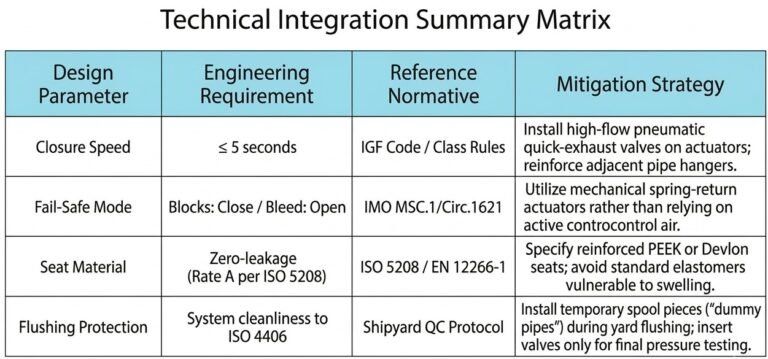
Double Block and Bleed valve integration in PFD
Double Block and Bleed valves are expensive piping components. All DBB valves installed onboard are not manual valves; instead, they are fitted with dedicated actuators linked to the ship’s automation system. A valve of this type can easily cost between $2,000 and $3,500, so during the project design and layout phase, it is essential to properly assess where they are required, and where they are not.
Procurement time must also be carefully assessed, as this type of valve is far less common than, for example, a standard butterfly valve. As a result, delayed ordering can easily add to an already longer delivery time due to limited availability in the market.
At Flowazur Consulting, during our basic engineering phase, we define all Double Block and Bleed valve positions and then support shipyards throughout the procurement process, facilitating both the engineering and procurement phases.
Book a call with one of our engineers to discuss your project in detail.
Frequently Asked Questions
Q: What is a double block and bleed valve?
A: An arrangement of two block valves in series plus a bleed valve that drains any fluid trapped between them, as defined in IMO Resolution MSC.391(95).
Q: Where does the IGF Code require double block and bleed valves on a methanol-fuelled ship?
A: MSC.1/Circ.1621 paragraph 6.4.4 requires them on the inert gas supply line, to stop methanol vapour migrating back into gas-safe spaces.
Q: Are double block and bleed valves also required on the fuel line to the engine?
A: The guidelines don’t use that exact term there, but class societies apply the same isolation logic to the fuel train by design equivalence.
Q: What are the two types of DBB valve arrangement?
A: A split-valve manifold with three separate valves, or a single integral valve body with two seats and an internal bleed port.
Q: How much does a DBB valve cost?
A: Typically $2,000–$3,500, with longer procurement lead times than standard valves.
Q: What happens if the bleed valve opens too early in the ESD sequence?
A: Methanol can flow into the drain system before the upstream block valve is fully seated, causing excessive erosion on the bleed valve seat.