
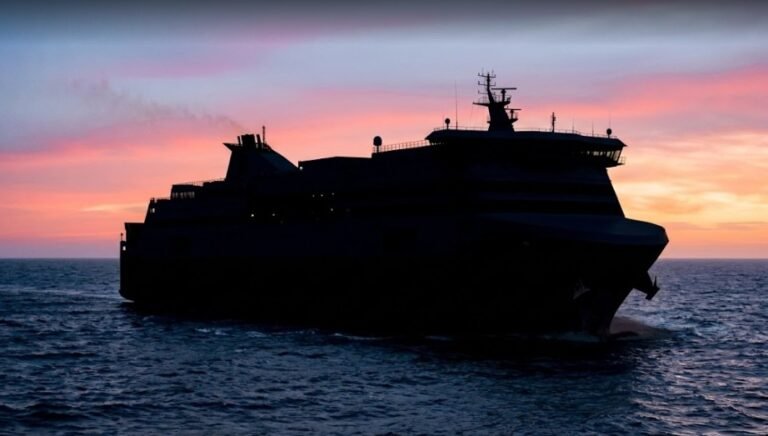
Methanol Retrofit projects are complex due to the numerous new pieces of equipment to be installed onboard, including new pipelines, valves, components, working logic and automation.
For this reason, we have been contacted to conduct a feasibility study on a RO-PAX.
(Unfortunately, the contract is covered by an NDA — Non-Disclosure Agreement — and therefore we cannot reveal any major data or detailed information about it.)
SHIPOWNER GOAL: Transforming one of the 2 main engines to run on dual-fuel and then, in the future, transforming the remaining one.
This will allow the shipowner to save significant costs under the ETS Carbon tax scheme.
Main Vessel Data:
- L = 217 m
- B = 30 m
- Passengers = 3000
- Cars = 1000
- Power = 57,6 Mw
- V = 27 knts
The project started by collecting all the main information, as usual.
- GA (General Arrangement)
- Capacity plan
- Systems PFD
Quick Facts
– Three existing tanks were evaluated for methanol storage; an autonomy calculation confirmed a large HFO tank could be converted.
– The onboard inspection found no room in the trunk-casing for the new air vent piping.
– The portside bunker station would have forced the methanol pipeline through the garage deck
– Final result: feasible with reservations
Studying, designing, inspecting and validating
During the overall project we applied our internal engineering process, composed of 4 phases: document analysis, design, systems engineering, and on-board validation. First of all, we analyzed and assessed all the information received: the capacity plan, general arrangement, route, installed power and engine type. We then moved to the design phase, where potential spaces were identified for the installation of new rooms and technical spaces, such as:
- Methanol Bunker Station
- Nitrogen Room
- Fuel Treatment Room
Three potential existing tanks were selected for conversion, and an assessment was conducted on each of them to fully determine the best solution available. An autonomy calculation was performed to establish how much fuel is required to satisfy the operational profile of the vessel and reach the bunkering ports.
The ship-autonomy calculation, the routing profile and the available onboard volume yielded a positive result, confirming that the methanol volume required for the vessel can be stored in a large HFO storage tank, suitably converted. The project then proceeded with the following steps: methanol systems PFD design (low flashpoint fuel supply system and auxiliaries) and piping routing assessment.
Validation: The Onboard Inspection
At Flowazur we validate our studies, assessments and designs with an in-depth onboard inspection. During the inspection, all the designed parts are verified on site. In fact, ship modifications are often not reflected in the drawings received, and “as-built” drawings are frequently not updated to reflect the last work carried out onboard.
Only an onboard inspection can determine with 100% reliability whether interferences exist that are capable of compromising the feasibility study results. This is where the project started to become more complex.
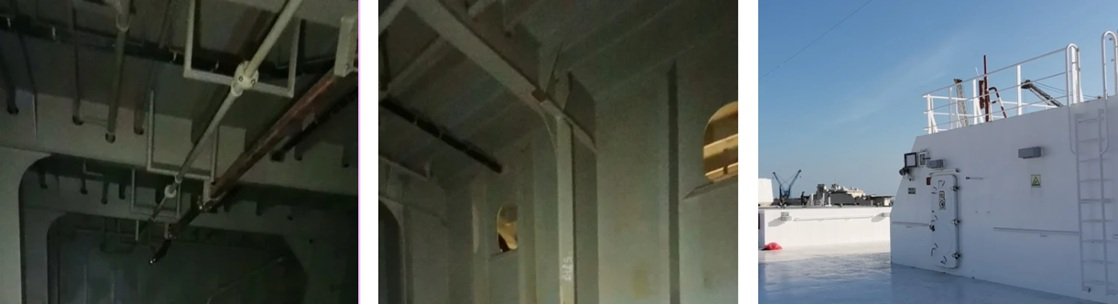
Photo: Void Inspection area to be transformed – Inspection of Air Vent mast position
Project Findings and Final Result
We began by inspecting the fuel tank, the void spaces where we had planned to install the fuel treatment room and the nitrogen room, and then proceeded to the mast for the air vent pipe inspection, covering the entire pipe routing.
It was precisely during this last inspection that issues emerged requiring an in-depth assessment. The trunk-casing has very limited space and cannot be split to accommodate the new air vent pipelines.
An alternative pipe routing was therefore investigated, but no suitable solution was found due to the diameter of the double-walled pipe.
WHAT WE FOUND
As a result, the only way to route the new air vent pipes from the methanol fuel tank to the P/V valves and mast would require the removal of 7 cabins to create space for the new double-walled pipe.
The portside bunker station also presented some critical issues. Unlike the starboard bunker station, where the pipeline can be routed directly down to the fuel treatment room, the portside bunker station presents a routing constraint that would force the methanol bunker pipeline to run through the garage deck. This solution is to be avoided as far as possible, given that the deck serves as a garage.
The proposed solution, to be submitted for class approval, consists of a double-walled pipe routed as close as possible to the ship’s side, protected by an inspectable steel structure. The outcome of this feasibility study was positive with reservations. This means the project is technically feasible, but requires additional work and therefore higher CAPEX.
If you are planning to retrofit one of your existing vessels, the project variables and the complexity behind them must be carefully managed to avoid rework or, in the worst case, a financial setback resulting from an incorrect initial assessment.
At Flowazur we are specialized in feasibility studies for methanol as a fuel, supporting shipowners and shipyards during newbuilding and retrofit projects. If the project moves forward, our Advanced Systems Integration Service service carries the methanol system engineering through to full integration.
Reducing project risk while speeding up engineering operations.