
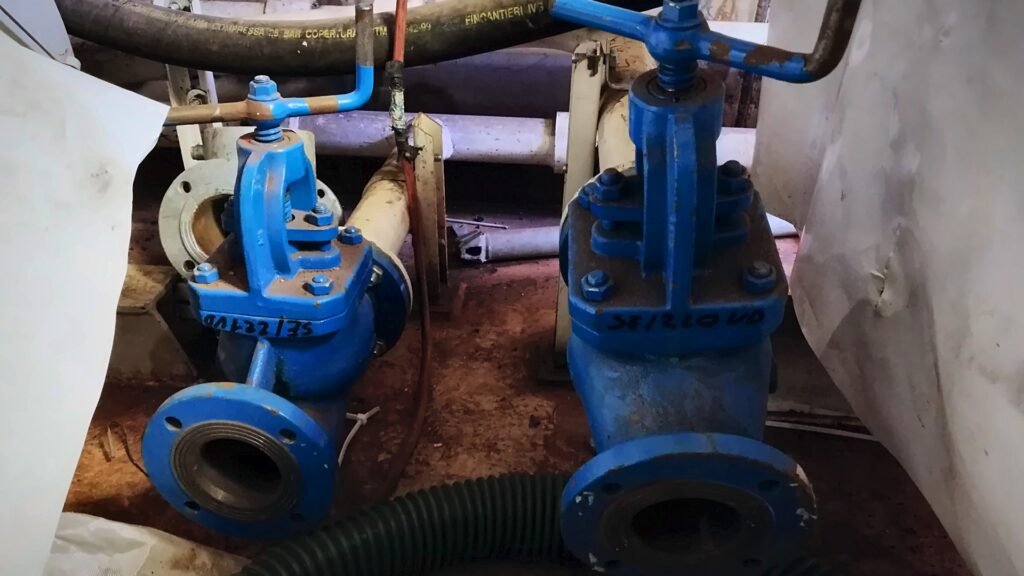
“Careful opening that valve, the flange is hot. You’ll burn yourself!”
How many times have you heard a line like this onboard? During shipyard commissioning, and later in daily operations, the crew opens and closes dozens of valves every day; they test a system, or they run it until it hits the target flow rate, pressure and temperature.
During hazard analysis and risk identification in the design phase, one of the key factors is how often a task is carried out.
It makes total sense.
The more often you repeat a task, the higher the chance of getting hurt; that’s even truer when the task carries a risk of its own. One of the main jobs of an engineer in marine piping design is to review each system and cut these risks as far as possible.
The Blow Down Boiler -Case Study
To see what we mean, take a boiler blowdown.
Blowdown is a routine operation (onboard and during commissioning). The crew performs it when the salt content of the boiler water climbs too high, so part of that water has to be flushed out and replaced with fresh distilled feed water.
The Blowdown Procedure, Step by Step
Here’s how it typically goes onboard:
- A water test shows too much salt, so a blowdown is needed.
- Depending on the issue, the crew runs one of two blows (or both):
- Surface blow: drains water near the water line to keep total dissolved solids (TDS) down.
- Bottom blow: clears settled sludge before it insulates the tubes and makes them overheat.
- The crew opens the overboard valve.
- A crew member opens the screw-down non-return (SDNR) valve by hand to flush out the dirty water.
- The blowdown water leaves at boiler temperature: about 170 °C at 7 bar(g)
At first glance, it doesn’t look hard. Look closer, though: the operator is handling a valve right next to a major heat source. Even with every part insulated, that alone is a clear risk.
Marine Piping Design for Safe Operation
The blowdown is just one simple example among the many tasks the crew carries out onboard.
Our Flowazur teams have followed several newbuilding projects, and they’ve spotted a constant pattern. Much of the rework on marine systems during newbuilding traces back to the same few problems:
- Valves that nobody can reach;
- Spool pipes that need removing but have no flanges;
- Clearances too tight to meet SOLAS (Chapter II-1 access requirements).
- Missing instruments, and too few controls or checks along the pipeline.
None of these mistakes is hard to fix. Still, they eat time, disrupt the schedule and cost money; above all, they force the crew into harder operations, and so raise the risk every time someone performs them.
Designing Marine Systems “Onboard First - Philosophy"
That’s why we believe a sound marine system starts from the onboard environment and the ship’s operations. The system itself comes after.
Understanding how a system works is one thing; understanding the many tasks the crew performs around it is much harder. Marine system engineers often design around the system’s own working parameters, and that’s perfectly fine.
But what about safety and operability?
Back to the blowdown valve. A good marine piping layout weighs the risk of the operation, so it places the valve where the operator can handle it easily, well away from flanges and other hot spool pipes.
It’s one simple decision. Yet it can improve safety for every crew member who’ll work onboard over the next 30 years.
That’s why an “Onboard First” design philosophy matters so much from the earliest project stages. It’s rarely applied, because few designers really know how the crew works onboard. Research backs this up: the CyClaDes project, whose crew-centered design findings the Nautical Institute turned into a guide for naval architects, found poor access to valves among the key layout issues, and concluded that many ship designers lack sea experience, which limits their grasp of routine operational needs
Planning a newbuilding, a refit or a complex retrofit? Talk to our engineering team before the layout is frozen; that’s when a good decision costs least.