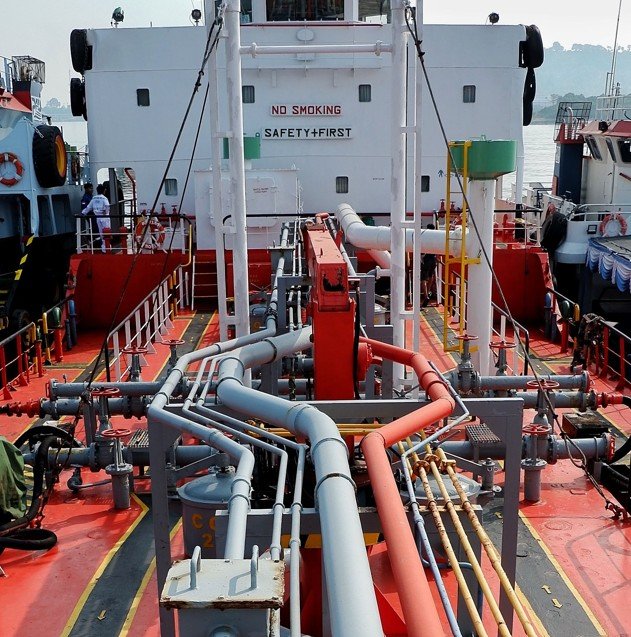
APPLICATION FIELD
IACS UR F20, “Inert Gas Systems,” applies to inert gas plants
It is a requirement applying to tankers required by SOLAS regulation II-2/4.5.5.1 to carry crude oil or petroleum products, including chemical tankers or other products with a similar fire hazard. The rule covers both major plant technologies in current use: traditional systems generating inert gas from boiler flue gas or a dedicated oil-fired generator, and the newer alternative of nitrogen generator systems that separate nitrogen directly from compressed air using membrane or adsorber technology.
PIPE CLASS / SYSTEM TYPE
F20 sits outside the P2.2 Class I/II/III system, it’s a fire and explosion prevention requirement for the cargo tank atmosphere, not a piping classification rule. The inert gas distribution piping itself is still classified and constructed under P1/P2 in the ordinary way; what F20 adds is a layer of safety-critical devices and material requirements.
RELATED RULES
- Statutory backdrop: SOLAS II-2/4.5.5.1 (and the associated 4.5.5.2, 4.5.3.4.2, 4.5.6.3, 11.6.3.4) is the primary trigger requiring inert gas system fitment on qualifying new tankers.
- Statutory backdrop: FSS Code Chapter 15, as amended by MSC.367(93), supplies the core technical content F20 is built on top of, F20 explicitly reads any reference to “Administration” in that chapter as meaning the relevant Classification Society.
- Statutory backdrop: IMO Resolution A.567(14) provides the parallel technical basis for chemical tanker inert gas systems, alongside FSS Code Ch.15 for oil tankers; F20.3.4 layers additional requirements from F20.2.3 on top of it.
- Statutory backdrop: SOLAS II-2/16.3.3, as amended by MSC.365(93), governs how the inert gas system is to be operated once installed.
- Cross-reference (unusual cross-domain reuse): UR M74, the Ballast Water Management System UR, explicitly borrows F20.4.4, F20.4.5 and F20.4.6 for certain in-line and ozone-injection BWMS technologies that use nitrogen or oxygen generation, substituting “ballast tanks/piping” for “cargo tanks/piping” throughout.
- Direct sibling: IACS Unified Interpretations addressing FSS Code paragraph 15.2.2.3.2.3.3 (separation between inert gas piping and cargo tanks) and paragraph 15.2.4.1.4 (access and ventilation for nitrogen generator receiver spaces) refine the underlying FSS Code text F20 incorporates.
RESTRICTION
Nitrogen generator output can’t exceed 5% oxygen by volume, with automatic discharge of “not in compliance” gas during start-up or abnormal operation as a mandatory, automatic response rather than a manual fallback.
At least two non-return valves are required in the inert gas supply main, one specifically arranged as double block-and-bleed, the second fitted with positive means of closure.
Compartments housing an oil-fired inert gas generator are treated as Category A machinery spaces for fire protection purposes without exception, regardless of the unit’s size.
And discharge locations for nitrogen system vent gases carry fixed distance criteria — oxygen-enriched air must vent outside the hazardous area, not within 3 metres of areas personnel transit, and not within 6 metres of machinery air intakes or ventilation inlets.
DESCRIPTION
F20’s structure deal with the two different ways ships generate that inert gas. The newer nitrogen generators strip oxygen out of compressed air, introducing their own hazards: feed air quality, continuous purity monitoring, and safe venting of the oxygen-enriched byproduct that separation inevitably produces
IMPORTANT NOTE
- The two-non-return-valve requirement in the inert gas supply main, including the double block-and-bleed arrangement, exists specifically to prevent cargo vapor migrating into the machinery space
- Nitrogen generator compartments carry their own siting and ventilation requirements: location outside the cargo area, independent mechanical extraction at 6 air changes per hour, a low oxygen alarm, and no direct access to accommodation.
Frequently Asked Questions
Q: What is IACS UR F20?
A: It’s the IACS Unified Requirement covering inert gas systems on tankers, built on FSS Code Chapter 15 and SOLAS II-2/4.5.5.1.
Q: What’s the maximum oxygen content allowed from a nitrogen generator?
A: 5% oxygen by volume, with automatic discharge of non-compliant gas during start-up or abnormal operation.
Q: How many non-return valves does the inert gas supply main need?
A: At least two; one arranged as double block-and-bleed, the other fitted with positive means of closure.
Q: Are oil-fired inert gas generator rooms treated as machinery spaces?
A: Yes. F20 treats them as Category A machinery spaces for fire protection, regardless of the unit’s size.
Q: Where can nitrogen system vent gases be discharged?
A: Outside the hazardous area, at least 3 metres from personnel-transit areas and 6 metres from machinery air intakes or ventilation inlets.
“Flowazur is not affiliated with, endorsed by, or sponsored by ISO, ASTM, ASME or API. All standard names and numbers are property of their respective organizations.”
Expert Marine and Piping Engineers at Your Side
Piping systems often go unnoticed until they cause major problems and major rework follows. Avoid uncertainty, reduce project risk, and keep your schedule on track with Flowazur Consulting.
Our team includes highly experienced, specialized:
- Piping Consultors
- Marine system engineers
- Piping System Engineer
- Technical Managers