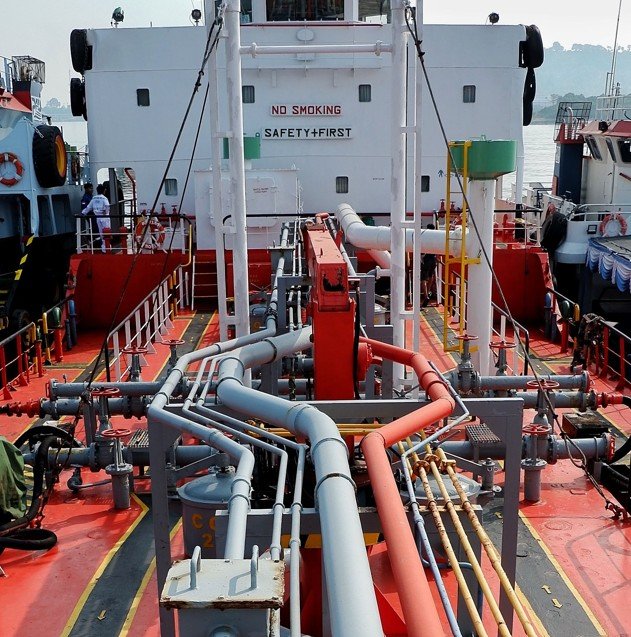
USED FOR:
Oil and gas industries including lower carbon energy — Piping systems on offshore platforms and onshore plants
Design, materials, and fabrication of piping systems on offshore production platforms (fixed and floating) and onshore oil/gas processing and gas liquefaction plants.
RELATED STANDARDS:
- API RP 14E – Design and Installation of Offshore Production Platform Piping Systems
- API RP 14C – Analysis, Design, Installation, and Testing of Safety Systems for Offshore Production Facilities
- ASME B31.3 – Process Piping
- ISO 15156 series (NACE MR0175) – Sour service materials
- ISO 13703-2 (Materials) and ISO 13703-3 (Fabrication, welding, inspection, testing)
DIMENSIONAL RANGE:
ISO 13703 doesn’t state a bore/diameter limit as such, offshore platform piping runs from small-bore instrument tubing up to large-diameter risers and flowlines, and sizing is driven by process and hydraulic criteria, not by a code-stated diameter range. What the standard does state explicitly is the pressure and temperature envelope: it covers piping systems up to 69 000 kPa (ga), with temperature limits governed by the properties of the materials referenced against ASME B31.3. Beyond that envelope, the standard may still be used, but special consideration must be given to material properties.
DESCRIPTION:
This is the standard we actually consider more useful than ISO 15649 for upstream work, because it goes beyond generic process piping and addresses platform-specific realities: flowlines, manifolds, risers, wellhead piping, pressure relief and flare/drain systems, noise and erosion control, and space-constrained layout. The original 2000 edition (based heavily on API RP 14E) has now been reorganized into a proper multi-part series: Part 2 (Materials, 2023) and Part 3 (Fabrication, welding, inspection, testing, 2023) have already been published; the design part (originally Clauses 1–8 of the 2000 edition) is expected to follow as Part 1. Until Part 1 is formally issued, the 2000 edition remains the reference for design.
IMPORTANT NOTES:
It explicitly excludes marine piping systems governed by classification societies (ballast, bilge, fire main, sprinkler, cooling water) and subsea umbilicals; a distinction worth remembering when a project cover both process piping and hull/marine systems, since the applicable code changes at that boundary.
Expert Marine and Piping Engineers at Your Side
Piping systems often go unnoticed until they cause major problems and major rework follows. Avoid uncertainty, reduce project risk, and keep your schedule on track with Flowazur Consulting.
Our team includes highly experienced, specialized:
- Piping Consultors
- Marine system engineers
- Piping System Engineer
- Technical Managers