
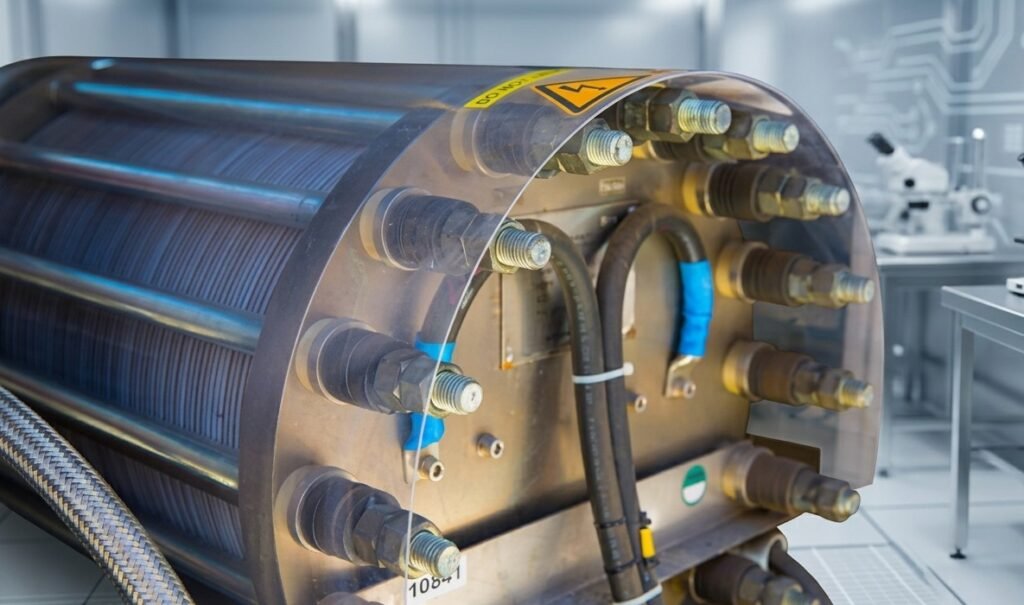
Fuel cells have moved from the periphery of maritime energy discussions to the centre of them.
Classification societies have published dedicated guidelines. The IMO’s strategy on greenhouse gas emissions has given shipowners a regulatory timeline that makes alternative energy technologies not merely interesting but necessary.
Across newbuild programmes and retrofit studies, the question is no longer whether fuel cells have a place in the future of shipping, but which technology, on which vessel type, with which fuel, and critically, how the system is actually engineered to work in a marine environment.
The answers to those questions are not immediate, and they are not the same for every project.
Quick Facts
– Of five commercial fuel cell types, only two technologies – PEM and Solid Oxide (SOFC) – are considered suitable for maritime use.
– PEM operates at 60–80°C, runs primarily on hydrogen, and can also use methanol through an onboard reformer.
– SOFC operates at 700–1,000°C and can internally reform methane, methanol, or ammonia without a separate external reformer.
– SOFC electrical efficiency can exceed 60%, versus PEM’s typical 50–60% range excluding auxiliary loads.
What a fuel cell actually does and why it matters for ship design
A fuel cell is an electrochemical energy conversion device.
It converts the chemical energy of a fuel directly into electrical energy through an electrochemical reaction, without combustion. That distinction matters for ship design in several ways.
The absence of combustion means no reciprocating components, significantly reduced acoustic contamination, lower vibration, and exhaust products that, depending on the fuel, can be substantially cleaner than those from a diesel engine or gas turbine.
For naval vessels, passenger ships, and research platforms where noise, vibration, and emissions are primary design constraints, those characteristics are not marginal advantages. They are significant.
But fuel cells are not all the same technology. Several variants exist, differentiated by:
- electrolyte material
- operating temperature,
- fuel compatibility,
- and tolerance for the conditions a ship will impose on them.
Five principal types have reached commercial or advanced development maturity: Polymer Electrolyte Membrane, Alkaline, Phosphoric Acid, Molten Carbonate, and Solid Oxide.
Each has a distinct electrochemical architecture and a distinct set of operating requirements. Of these, only two have demonstrated good suitability for maritime applications.
Why the maritime sector has converged on two technologies
Alkaline fuel cells were among the earliest fuel cell technologies to reach practical application, they powered the Apollo spacecraft, but their sensitivity to carbon dioxide (CO2) in the oxidant stream makes them not suitable to marine environments where atmospheric air is the oxygen source.
CO₂ reacts with the alkaline electrolyte, degrading it progressively and requiring either pure oxygen supply or complex air purification systems that add weight, volume, and maintenance burden. Neither is practical on a commercial vessel.
Phosphoric Acid fuel cells operate at intermediate temperatures, around 150 to 200 degrees Celsius, and have seen some stationary power generation use, but their relatively low power density, the corrosive nature of the phosphoric acid electrolyte, and limited commercial development momentum have kept them outside serious maritime consideration.
Molten Carbonate fuel cells operate at even higher temperatures , above 600 degrees Celsius with an electrolyte that is liquid at operating temperature, creating materials compatibility and sealing challenges that become bigger on a vessel subject to motion, vibration, and the maintenance realities of a working ship.
That leaves PEM and Solid Oxide, and between them they cover the range of applications the maritime sector is actually pursuing.
PEM fuel cells: the "almost ready" technology for ships
Polymer Electrolyte Membrane fuel cells operate at low temperatures, typically between 60 and 80 degrees Celsius for the conventional low-temperature variant.
The electrolyte is a solid polymer membrane, most commonly Nafion or an equivalent perfluorosulfonic acid material, which conducts protons from anode to cathode while remaining electrically insulating. The reaction at the anode oxidises hydrogen, releasing protons and electrons; the protons migrate through the membrane while the electrons travel through the external circuit, producing electrical current; at the cathode, protons, electrons, and oxygen combine to produce water.
The relative simplicity of that process, the solid electrolyte, the fast start-up and load response, and the well-developed commercial supply chain for PEM stacks make this technology the most immediately deployable for marine applications. Units in the 100 to 500 kW range from established manufacturers are suitable for maritime industries, and there are many pilot projects underway. The primary fuel is hydrogen, which must be supplied at sufficient purity, PEM systems are sensitive to carbon monoxide (CO) contamination, which damages the platinum catalyst, but methanol can also serve as a fuel through an onboard reformer that converts it to a hydrogen-rich gas stream before it reaches the stack.
Electrical efficiency in maritime service typically is in the range of 50 to 60 percent, though this figure excludes the air compressors, cooling pumps, and control systems that reduce net system efficiency.
The low operating temperature is both an advantage and a constraint.
It means fast start-up and no requirement for high-temperature materials throughout the balance-of-plant, but it also means the waste heat is available at relatively low grade, limiting the extent to which it can be usefully recovered for other ship services.
Solid Oxide fuel cells: the higher-efficiency, longer-horizon option
Solid Oxide fuel cells operate at significantly higher temperatures, typically between 700 and 1,000 degrees Celsius depending on the specific electrolyte material and cell architecture.
At these temperatures, a ceramic electrolyte, most commonly yttria-stabilised zirconia, conducts oxygen ions rather than protons, and the electrochemical reaction proceeds in the reverse direction compared to PEM: oxygen is reduced at the cathode, oxygen ions migrate through the electrolyte, and fuel is oxidised at the anode.
The high operating temperature brings several important characteristics. SOFC systems can internally reform hydrocarbon fuels such as methane, methanol, and, in certain configurations, ammonia, directly within the stack, eliminating or reducing the need for a separate external reformer.
Electrical efficiency at system level can reach and in some configurations exceed 60 percent, and the high-grade waste heat available from the exhaust stream, at temperatures that can support steam generation or additional thermodynamic cycles, makes combined heat and power configurations very attractive.
The constraints are equally significant. Start-up from cold to operating temperature takes time, measured in hours for larger systems rather than minutes, which affects how SOFC systems can be integrated into vessel power management architectures.
The ceramic components are sensitive to rapid thermal cycling and mechanical shock, which demands attention to mounting arrangements, vibration isolation, and operational procedures on a working vessel.
Fuel Cell Pilot Projects: Engineering and R&D
Having clarified the most well-known fuel cell technologies and their integration challenges onboard, it is clear that both the R&D department and the engineering team play a crucial role in adopting this technology at sea.
The fuel supply system, whether hydrogen at pressure, methanol in liquid form, or LNG with reforming equipment; must deliver fuel at the correct pressure, temperature, purity, and flow rate across the full operating range of the fuel cell.
The cooling system must manage heat dissipation within the constraints of the available seawater temperature and the fuel cell’s operating window, using deionised water circuits in the case of PEM to avoid conductivity-related electrical issues within the stack.
The process air and oxidant supply system must deliver the correct stoichiometric flow rate to the cathode, insufficient oxidant flow creates cell reversal conditions that cause irreversible stack damage.
The power conditioning system must interface between the fuel cell’s DC output and the vessel’s AC electrical distribution, managing load following and protecting the stack from electrical transients.
At Flowazur Consulting, our advanced integration service covers the full scope of fuel cell integration onboard. We begin by assessing the vessel’s load profile across different operating scenarios, then progress to piping engineering and the integration of all fuel cell sub-systems. We calculate the required air flow rates and thermal exchanges, and we investigate possible operational issues to reduce project risk as much as possible while accelerating the engineering phase.
Book a call with one of our engineers to discuss your project in detail.
Frequently Asked Questions
Q: What’s the operating temperature difference between PEM and SOFC?
A: PEM runs at 60–80°C; SOFC runs at 700–1,000°C.
Q: Can PEM fuel cells run on methanol?
A: Yes, through an onboard reformer that converts methanol into a hydrogen-rich gas stream before it reaches the stack.
Q: Why does SOFC take longer to start up than PEM?
A: Its ceramic components need hours to reach operating temperature.
Q: Which fuel cell type offers higher efficiency?
A: SOFC, which can exceed 60% electrical efficiency at system level, versus PEM’s typical 50–60%.
Q: What subsystems does integrating a fuel cell onboard require?
A: A fuel supply system, a cooling system, a process air/oxidant supply system, and a power conditioning system.