
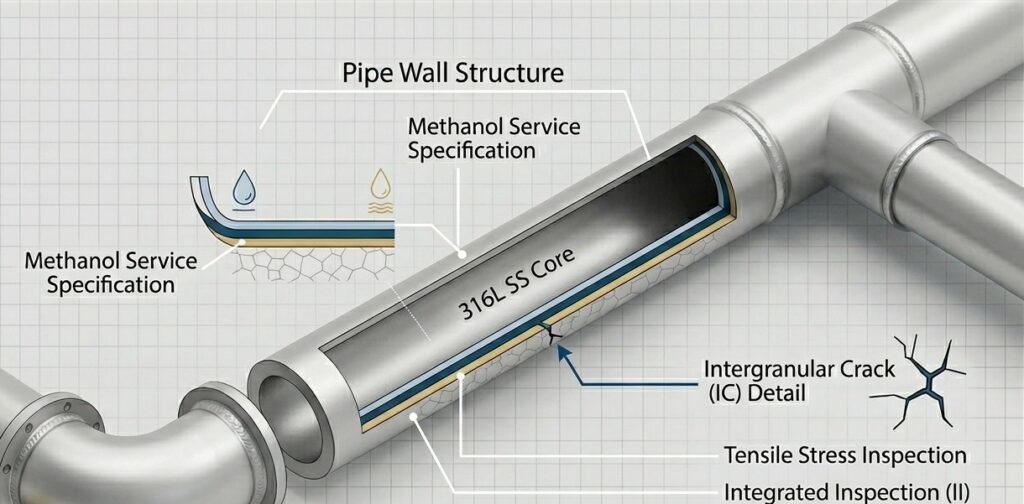
Retrofitting a vessel to run on dual-fuel systems, or a newbuilding methanol-fuelled ship, brings chemical realities that a standard marine piping specification simply doesn’t account for.
Unlike conventional Marine Diesel Oil (MDO), Marine Gas Oil (MGO), or Heavy Fuel Oil (HFO), methanol is a highly polar, volatile alcohol; a strong solvent and an aggressive electrolyte.
When it is in contact with the wrong metallurgy or the wrong elastomer, methanol causes rapid material degradation, from macro-level polymer dissolution down to micro-level Intergranular Stress Corrosion Cracking (IGSCC).
Under the IMO IGF Code (resolution MSC.391(95)) and MSC.1/Circ.1621, methanol-fuelled ships need double-barrier arrangements and mitigation measures wherever the fuel could be released, and behind that requirement there are rigorous, strict material compatibility matrix.
Worth being precise here: neither the IGF Code nor MSC.1/Circ.1621 hands us a fixed list of banned metals.
What they require is that we demonstrate compatibility for every wetted material in the system. In practice, that demonstration requirement rules a few materials out almost automatically.
For the piping engineer, this means stepping away from conventional carbon steel and standard fluoroelastomer defaults. It means specifying material interfaces that can actually stand up to the chemistry of commercial-grade methyl alcohol.
Quick Facts
– Zinc, galvanized steel, and copper alloys form soluble metal alkoxides in methanol and should not be used in wetted service.
– 316L stainless steel is the baseline standard, but chlorides and water dissolved in the fuel, not the methanol itself, drive stress corrosion cracking risk (CCS).
– Duplex 2205 offers a PREN of roughly 35–38 versus 23–25 for 316L, making it the safer choice for high-pressure, high-vibration, or open-deck runs.
– Standard FKM (Viton) seals can swell over 30–40% in methanol and lose sealing integrity; FFKM, EPDM, or PTFE are the compatible alternatives.
– Cross-contamination from carbon steel tools during fabrication can trigger galvanic pitting and pinhole leaks
1. Metallurgy: Managing SCC
Designing a methanol piping system means keeping tight control over which materials we let near the fuel. Two families are essentially off the table from the outset:
- Zinc and galvanized steel. Methanol attacks zinc coatings directly, forming soluble zinc alkoxides that strip the galvanizing and foul downstream equipment.
- Copper and copper alloys (brass, bronze). The same alkoxide-forming reaction applies, and it happens fast enough that most class societies and methanol suppliers flag copper alloys as unsuitable for wetted methanol service.
Lead and aluminium require more attention; aluminium alloys are rated as broadly satisfactory by several reference sources for methanol service, provided the alloy, surface condition, and water/chloride content of the fuel are controlled; but they remain sensitive to impurities and shouldn’t be assumed safe without checking the specific alloy against the actual fuel quality.
Lead alloys, for their part, do see legitimate use as metal gasket material in methanol service.
In any case, the general rule is always valid.
Material compatibility assessment must be carried out against the specific alloy and application, not against the metal’s name alone, and documented accordingly for class review.
Where methanol does react with a susceptible metal, it forms soluble metal alkoxides. Over time that corrodes the pipe wall and builds up chemical precipitates that foul fuel injectors and clog high-pressure filters on the low-flashpoint fuel system (LFFS). As a rule, galvanized steel piping and brass-bodied valves have no place in a methanol fuel line or vent loop.
Stainless Steel Selection: 316L vs. Duplex Alloys
The baseline standard for onboard methanol fuel piping is Austenitic Stainless Steel 316L (UNS S31603), chosen mainly for its low carbon content (below 0.03%), which limits carbide precipitation during welding. But specifying “316L” is only the first step, the system still has to be designed to resist stress corrosion cracking (SCC).
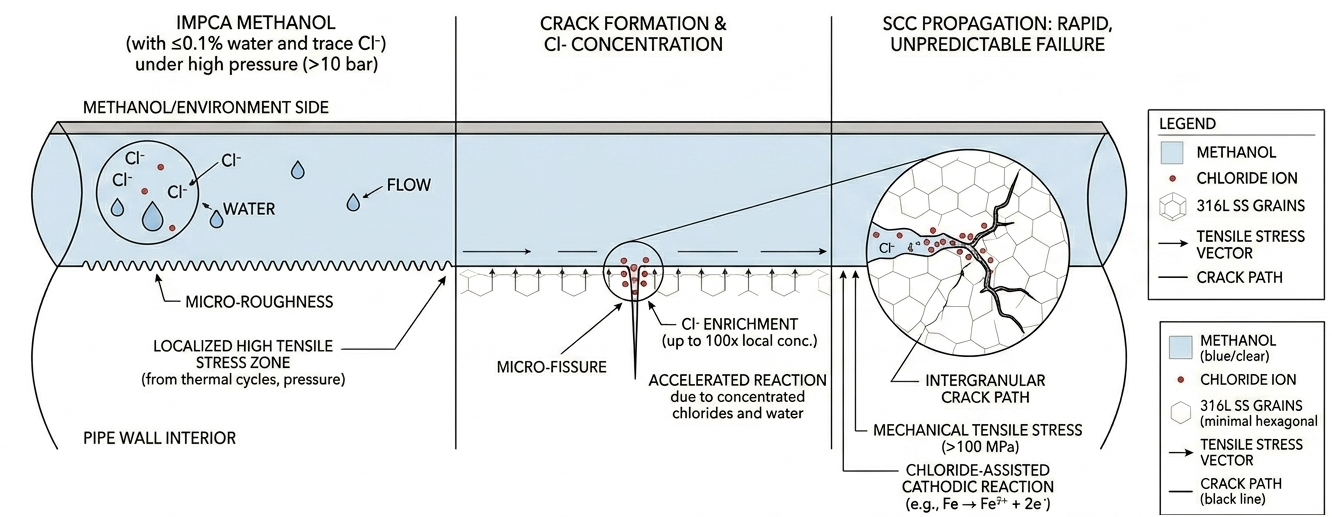
Pure methanol on its own isn’t particularly corrosive to stainless steel. The risk comes from what’s dissolved in it: commercial marine methanol bunkered to IMPCA reference specifications can carry water content up to 0.1% w/w and trace chloride ions (the IMPCA spec caps chlorides at 0.5 mg/kg) picked up from the marine supply chain.
When stainless steel piping runs under sustained mechanical stress such as high localised pressure in the LFFS line, combined with thermal expansion cycling, those chlorides can concentrate in micro-fissures and drive fast, unpredictable SCC failures. The specific pressure and stress point that tips a given design into that risk zone is project-specific and worth confirming through a proper stress analysis rather than assuming a fixed number.
For high-pressure, high-vibration engine room runs, or piping routed through open decks exposed to salt spray, stepping up to Duplex Stainless Steel 2205 (UNS S32205) gives real risk mitigation. Duplex 2205’s balanced 50/50 austenitic-ferritic microstructure gives it noticeably higher yield strength and a higher Pitting Resistance Equivalent Number (PREN) than 316L.

Standard 316L: PREN range approx. 23-25
Duplex 2205: PREN range approx. 35 – 38
This higher PREN score directly translates to a lower probability of localized pitting, which serves as the initiation point for catastrophic stress corrosion cracks.
2. Elastomer Degradation: The Problem of Standard Fluoropolymers
The most common failure points in a retrofitted fuel system are often the small stuff: soft seals, O-rings, and valve seats across the piping network.
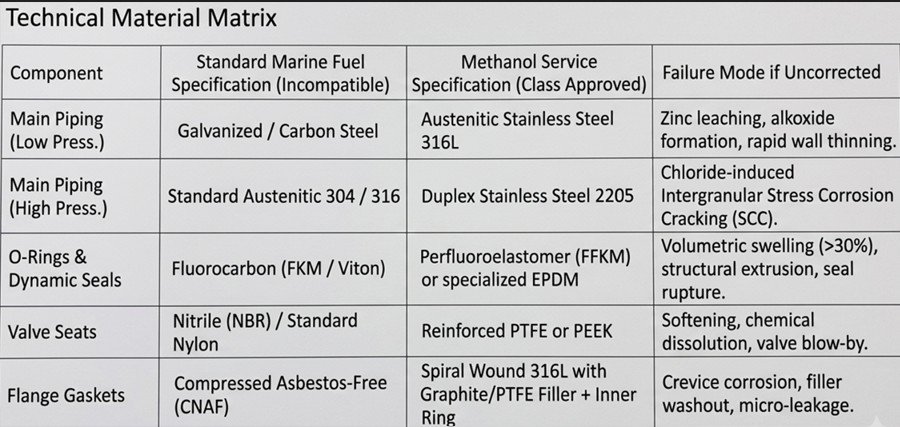
Standard marine designs lean heavily on Fluorocarbon Elastomers (FKM), better known as Viton. FKM handles petroleum hydrocarbons well, but it degrades fast when it meets methanol.
The Mechanics of Polymer Swelling
Methanol molecules are small and highly polar, which lets them penetrate the polymer matrix of standard FKM quickly. The elastomer absorbs the solvent, and the result is significant volumetric swelling, often well beyond 30–40%, alongside a sharp drop in tensile strength and a near-total loss of elasticity.
Once swollen, the seal can push out of its machined groove, fail during system depressurisation, or tear during valve actuation, resulting in an immediate loss of containment.
Polymer Alternatives
To keep sealing integrity over the long run, we specify compatible polymers:
- Perfluoroelastomers (FFKM): the gold standard for methanol service. FFKM’s fully fluorinated carbon backbone shields the polymer chain, giving near-total chemical inertness; high-grade FFKM materials typically hold volumetric swell to a few percent or less under continuous exposure, though the exact figure depends on the specific compound and should be confirmed against the manufacturer’s data.
- Ethylene Propylene Diene Monomer (EPDM): a strong, cost-effective option for non-petroleum-blended methanol systems. Being a non-polar hydrocarbon rubber, EPDM resists methanol’s polar molecules well. One important caveat: EPDM is entirely incompatible with conventional marine gas oils (MGO), so it can’t be used anywhere the system might see both fuels.
- Polytetrafluoroethylene (PTFE): pure or glass-reinforced PTFE offers excellent chemical resistance to methanol and works well for rigid valve seats and spiral-wound flange gaskets; provided the design accounts for PTFE’s natural tendency toward cold flow (creep) under sustained compressive load.
The Shipyard Reality: Preventing Cross-Contamination During Fabrication
Specifying 316L or Duplex 2205 on an engineering drawing is only half the battle. When all the information lands on the shipyard, execution risks shift from design to fabrication, assembly phase and quality control.
In many conventional shipyards, the same pipe-fitting workshop or sub-contracted company handles both carbon steel and stainless steel spools.
If a shipyard worker uses a carbon steel grinding disc or a wire brush on a stainless steel methanol pipe weld, microscopic carbon steel particles become embedded in the stainless steel surface, damaging the protective chromium oxide (Cr2O3) passive layer and creating a localized galvanic cell.
When the system is commissioned and filled with methanol, these contaminated weld zones undergo rapid galvanic pitting, potentially causing pinhole leaks within months of delivery.
Another major mistake happens when valves, pumps, or other piping elements are purchased without checking each individual component to determine whether any material incompatibility exists.
After a brief operational period, when everything seems to be working well, a leak occurs, and two days after, another one appears, and so on. The new system starts showing the same phenomena (leaks or gasket deterioration) in multiple areas.
This is a clear sign that the wrong material has been installed in the system. As a consequence, new valves, gaskets (or other components) must be purchased and delivered, the marine system must be stopped and flushed, and the incompatible elements dismounted. Then the newly purchased elements need to be installed.
At Flowazur Consulting, we support shipyards during the basic engineering phase, where all the materials are defined and procurement starts.
With our services and specialized marine systems engineers, we help you avoid material compatibility issues and costly rework.
Book a call with one of our engineers to discuss your project in detail.
Frequently Asked Questions
Q: Why is methanol more corrosive to piping systems than conventional marine fuels?
A: Methanol is a highly polar, volatile alcohol that acts as a strong solvent and aggressive electrolyte, unlike MDO, MGO, or HFO.
Q: Which metals should never be used in methanol wetted service?
A: Zinc, galvanized steel, and copper alloys (brass, bronze) — they react with methanol to form soluble metal alkoxides.
Q: Is 316L stainless steel enough for methanol fuel piping?
A: It’s the baseline standard, but stress corrosion cracking risk comes from chlorides and water in the fuel, so the system still needs to be designed and stressed accordingly.
Q: When should Duplex 2205 be used instead of 316L?
A: For high-pressure, high-vibration engine room runs or piping exposed to salt spray on open decks, where its higher PREN gives better pitting resistance.
Q: Can standard Viton (FKM) seals be used with methanol?
A: No. FKM degrades and swells significantly in methanol; FFKM, EPDM, or PTFE should be specified instead depending on the application.
Q: What causes galvanic pitting in stainless steel methanol piping at the shipyard?
A: Using carbon steel tools (grinding discs, wire brushes) on stainless steel welds embeds particles that damage the passive chromium oxide layer, creating a localized galvanic cell.