
In alternative fuel retrofits, the transition to methanol often highlights the cost of major machinery components such as Fuel Supply System (FSS) skids or dual-fuel main engines.
However, one of the many variables that can cause budget issues in methanol retrofit projects is linked to the double-walled pipe production and assembly phase and, in particular, to the assembly step itself.
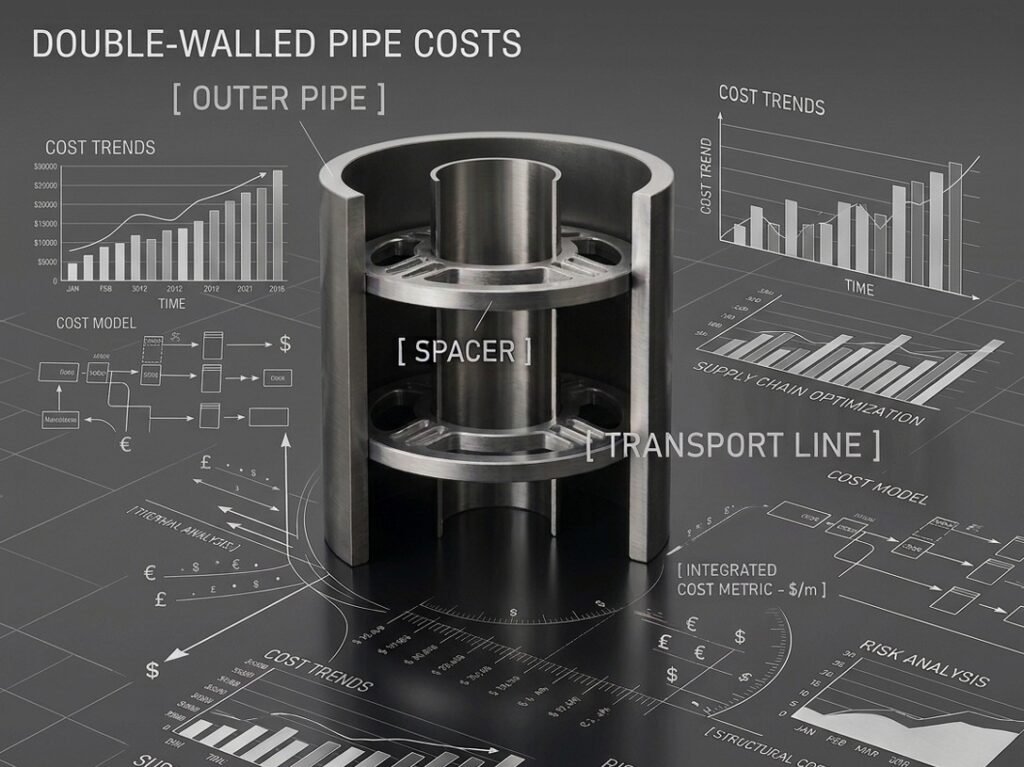
Double-walled piping (also known as jacket piping) requires two concentric pressure boundaries and, due to its higher rigidity, cannot be adjusted on-site using standard pipe-bending or field-welding methods.
In practice, methods commonly used onboard consist of adapting and sometimes forcing the pipe into position to reach the next pipe socket or flange.
Although this practice is well known to be incorrect, as it traps stress inside the pipeline, it is widely used during shipbuilding and retrofit operations where confined spaces and complex geometry make pipeline design and assembly considerably more challenging than in shore-based installations.
This assembly approach, which leaves little room for design error, is not permitted with double-walled piping. Every misalignment results in scrapped spool pieces and lost schedule days.
Quick Facts
- Field-fitting double-walled piping onboard typically increases total piping expenditure by 70% to 80% compared to prefabrication.
- A standard 3-inch/5-inch stainless steel spool joint takes 4 to 5 man-hours to weld in a controlled workshop, versus 8 to 14 man-hours for the same joint fitted onboard.
- Specialized shipyard labor rates range from $65 to $95 per hour (US-based reference figures).
- Prefabricating 150 meters of double-walled piping can cut the drydock installation window from 22 days to as little as 8 days.
Cost Breakdown: Prefabrication vs. Field-Fitting
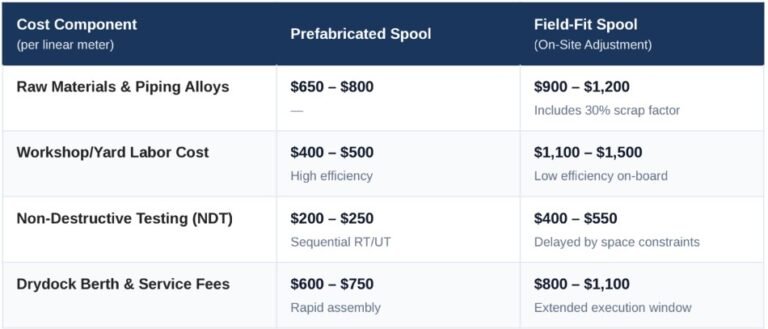
The financial differences between fabricating double-walled spools in a controlled workshop versus fitting them directly on a vessel during drydocking are substantial. In modern European and Asian repair yards, labor rates and production efficiencies vary significantly depending on the workspace environment. Therefore, providing a well-defined cost estimate is not possible.
The figures below are US-based references. For EU equivalents, costs can be estimated at 15–30% below the total US figures.
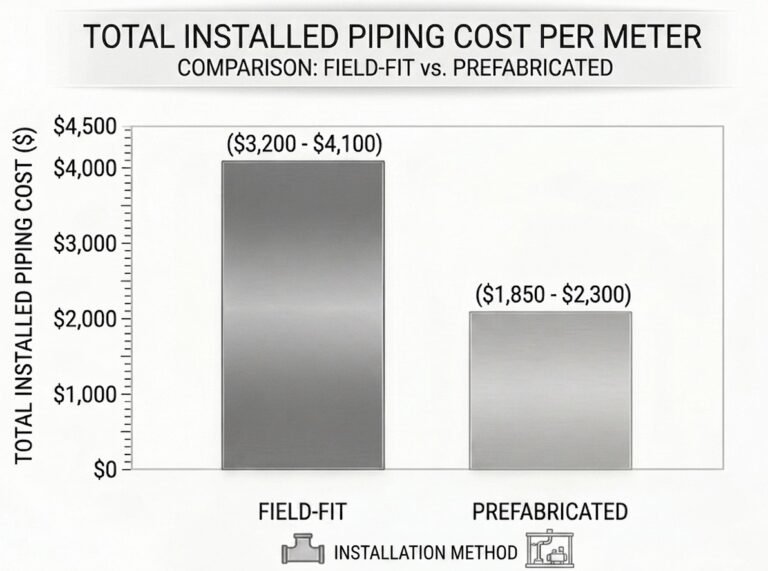
To compare the relative double-walled pipe costs, the following table breaks down average industry costs for engineering, producing, and installing marine-grade stainless steel (316L) double-walled piping, based on a standard 3-inch inner transport pipe and a 5-inch outer containment jacket:
On average, relying on traditional field-fitting methods commonly used onboard during retrofitting and newbuilding projects leads to a 70% to 80% increase in total piping expenditure.
This cost penalty varies depending on the vessel’s structure, available spaces, and the pipelines already present at the time of installation.
While this consideration applies to all piping systems, it is particularly significant for high-cost piping technologies such as double-walled pipe.
Work Efficiency and the Man Power Cost
In a controlled production facility, a welding team operates at peak efficiency. The workspace is well-lit, positioned horizontally, and sheltered from weather conditions. This environment allows a standard 3-inch/5-inch stainless steel coaxial spool joint to be fit, welded, and prepared for inspection in approximately 4 to 5 man-hours.
When this same operation is shifted to a narrow and uncomfortable machinery space or a pipe-tunnel during a drydock retrofit project, work dynamics change significantly:
Ergonomic and Access Constraints: Welders must work in tight spaces, often handling overhead or vertically fixed joints that require mirrors or specialized physical positioning.
Complex Multi-Stage Execution: A field welder cannot simply execute a single weld. They must weld the inner core pipe, pause production, clear the space for an NDT technician to perform radiographic testing, wait for the clearance report, slide the outer jacket into position, and then execute the final closure weld.
- The Man-Hour Penalty: Because of these interruptions and tight working conditions, the required labor time spikes to 8 to 14 man-hours per joint. In shipyards with specialized labor rates ranging from $65 to $95 per hour, this efficiency loss adds thousands of dollars in unbudgeted labor costs for every single pipe run.
Quantifying the Drydock Timeline Financial Impact
The total cost of a methanol fuel system retrofit, material and piping aside, is tied to the duration of the vessel’s drydocking period. Commercial vessels have high daily costs from fuel and manpower onboard, and on top of that, shipyard drydock fees accumulate quickly.
Drydock Days Saved via 100% Prefabrication. The ideal scenario
- Field-Fit: 22 Days (Extended fitting, testing, and rework)
- Prefabricated: 8 Days (Direct bolt-down and rapid inspection)
Consider a standard retrofitting project involving the installation of 150 meters of double-walled methanol distribution piping.
The Field-Fit Path: Fabricating, mounting, sequentially welding, and field-testing 150 meters of coaxial lines on-board may extend the drydock timeline by 22 days.
The Prefabricated Path: Delivering 100% pre-tested, class-approved modular spools directly to the drydock shifts the onboard work from fabrication to assembly. The yard simply brings the spools into position, bolts them down at the flanged connections, and executes only a minimal number of pre-planned field-fit welds. This reduces the installation window to just 8 days.
Saving 14 drydock days dramatically alters project financials:

For a mid-sized container ship or product tanker, a conservative daily drydock service fee of $15,000 combined with a commercial charter rate of $25,000 per day means that reducing the drydock window by 14 days saves $560,000 in project overhead and preserved revenue.
While a 100% prefabricated spool installation is theoretically achievable, assuming a more realistic 70% prefabrication rate, the resulting saving amounts to $392,000.
Precise Engineering Means Important Savings
In projects where high material costs combine with expensive labor and drydock fees, the project control and engineering phase is crucial to achieving significant cost savings.
The example above illustrates the financial impact of the installation approach chosen for double-walled piping. Planning a methanol retrofit project is not a straightforward task, considering the number of systems involved:
- Air vent system (methanol tanks)
- Ventilation system (dedicated to methanol)
- Drainage system (methanol)
- Bilge system (methanol)
- Low flashpoint fuel supply system
- Transfer system
- Bunkering system
- Nitrogen system
The complexity of managing all these systems simultaneously can easily overwhelm an engineering team, leading to insufficient attention to the assembly phase, resulting in numerous reworks and significant additional costs.
At Flowazur Consulting, through our piping engineering service, we support shipowners and shipyards throughout this critical phase, optimizing both the engineering and the assembly cost strategy.
Book a call with one of our engineers to discuss your project in detail.
Frequently Asked Questions
Q: Why is field-fitting double-walled pipe more expensive than prefabrication?
A: Field-fitting forces welders to work in tight, poorly accessible spaces and pause for radiographic testing between welds, which raises labor time from 4-5 to 8-14 man-hours per joint.
Q: How much can prefabrication reduce drydock time?
A: For 150 meters of double-walled piping, prefabrication can cut the installation window from 22 days to 8 days.
Q: What cost increase does field-fitting typically cause?
A: Relying on traditional field-fitting methods typically increases total piping expenditure by 70% to 80%.
Q: Can double-walled pipe be adjusted or bent on-site like standard piping?
A: No. Its higher rigidity means it cannot be adjusted using standard pipe-bending or field-welding methods, so any misalignment results in scrapped spool pieces.
Q: How much can a shipowner save by reducing drydock time through prefabrication?
A: For a mid-sized vessel, saving 14 drydock days can preserve around $560,000 in overhead and charter revenue, or about $392,000 at a more realistic 70% prefabrication rate.
Q: Are these cost figures valid outside the US?
A: The figures are US-based references; EU equivalents can be estimated at 15-30% below the total US figures.