
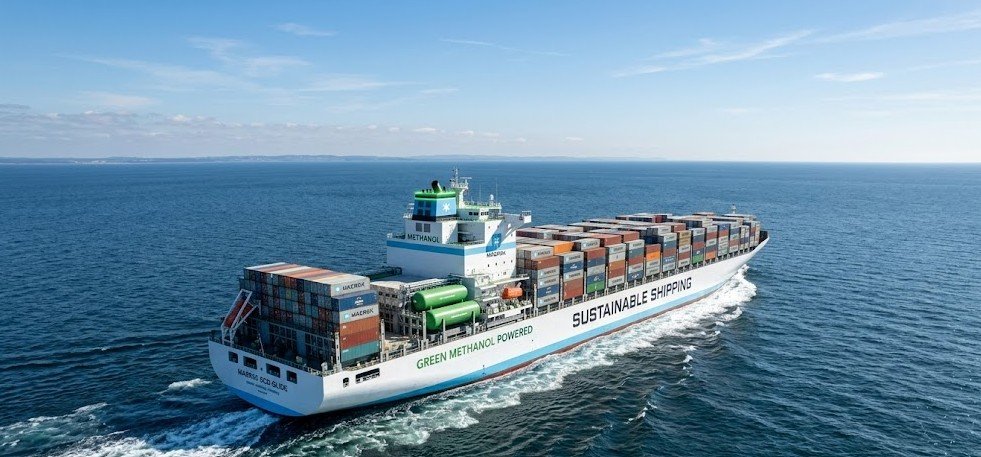
The maritime sector has been moving toward alternative fuels for a while now, and low-flashpoint fuels have turned the Methanol Fuel Treatment Room FTR ( also known as fuel preparation room FPR) into one of the most critical spaces onboard modern vessels.
Unlike a conventional heavy fuel oil (HFO) handling space, the purifier room for example, an FTR managing methyl alcohol is an extremely sensitive point, mostly because there are many skids, threaded connections and flanges. More non-welded joints means a higher likelihood of leakage, and with methanol that means explosive vapour risk, not just an oily bilge to mop up.
Methanol isn’t covered directly by the IGF Code text, which was written around LNG; it sits under the IMO’s Interim Guidelines for the Safety of Ships Using Methyl/Ethyl Alcohol as Fuel (MSC.1/Circ.1621, approved by MSC 102 in 2020), applied through the IGF Code’s alternative design route (Part A-1) and demonstrated against SOLAS regulation II-1/55.
This distinction matters in practice: it means the FTR isn’t checked against a numbered IGF Code section the way an LNG fuel preparation room would be, but against the Interim Guidelines’ own provisions, plus whatever a given class society (BV, DNV, ClassNK, LR, RINA) has folded into its own rule set for methanol-fuelled ships.
IMO is currently working to fold these Interim Guidelines into mandatory IGF Code chapters, so it’s worth keeping an eye on how CCC sessions progress over the next few years.
Quick Facts
– Methanol isn’t covered by a numbered IGF Code section; it’s regulated through MSC.1/Circ.1621.
– The FTR is classified as a Zone 1 hazardous area, requiring independent mechanical ventilation at 30 air changes per hour (ACH).
– The FTR needs A-60 fire boundaries whenever it shares a bulkhead with a Category A machinery space.
– Entrance from an enclosed space must go through an airlock with a minimum deck area of 1.5 m².
– Positioning the FTR close to the fuel tank and the consumers is the most effective way to cut costly double-walled piping.
The Regulatory Baseline: MSC.1/Circ.1621 and Hazardous Zones
The FTR houses the fuel preparation equipment. The mains are:
- Low Pressure Pump to suction the fuel from the methanol Daily Tank
- Duplex Filter for removing methanol impurities, with redundant functionality for maintenance purposes and uninterrupted operation
- Heat Exchangers for conditioning the methanol temperature and reaching the temperature required by the main engine (or other consumers)
- Fuel Train Valve: the skid responsible for cutting off the fuel supply in an ESD scenario and for constantly monitoring the physical properties of the supplied fuel, such as pressure, flow rate and temperature
- If required, a High Pressure Pump to bring the methanol up to the injection pressure required by the main engine, a figure that varies by engine make and model and should always be taken from the OEM’s technical documentation.
Considering methanol’s low flashpoint, around 11–12°C, and the number of flanged connections present into the fuel treatment room, the result is a hazardous area that has to be treated with rigour.
Area Classification and Ventilation Requirements
Under the Interim Guidelines, and as reflected in class societies’ own methanol rules (Bureau Veritas NR670 among them, or ClassNK’s Guidelines for Methanol/Ethanol Fuelled Vessels), the interior of a Methanol FTR is treated as a Zone 1 hazardous area for classification purposes. This drives a set of specific engineering controls:
- Mechanical Ventilation: The room must be fitted with an independent, negative-pressure mechanical ventilation system providing at least 30 air changes per hour (ACH) a figure consistent with the ventilation requirement long established for LNG fuel preparation rooms under the IGF Code and carried across into methanol practice. The exhaust fans must be of a non-sparking design, and the ducting layout must eliminate any potential stagnant gas pockets, particularly near the floor, since methanol vapour is heavier than air.
- Structural Boundaries: The FTR is generally enclosed by A-60 class boundaries to isolate it from Category A machinery spaces and other high fire-risk areas, the same fire boundary philosophy IMO applies to other low-flashpoint fuel spaces, carried through into class societies’ methanol notations.
- Access Arrangement: Entrance to the FTR from an enclosed space must be via airlock, fitted with self-closing doors and its own mechanical ventilation, kept at positive pressure relative to the FTR. The Interim Guidelines set a minimum airlock deck area of 1.5 m² (MSC.1/Circ.1621, §5.12).
Advanced Piping Engineering: Coaxial Design and Stress Management
The physical properties of methanol: low viscosity, small molecular size, and real toxicity on top of flammability mean its entire piping network needs careful engineering.
Under the Interim Guidelines, methanol fuel piping outside the FTR or running through enclosed spaces requires a secondary barrier. In practice this is satisfied with double-walled (coaxial) piping, though the same provision also allows a ventilated duct fitted with gas detection as an equivalent solution; worth raising with the client early, since a duct can sometimes be cheaper to route than coaxial pipe on long, straight runs.
The double-walled pipe working philosophy is straightforward on paper: an inner transport pipe, an annular space filled with nitrogen or continuously ventilated by mechanical extraction, coupled with gas detection or liquid leakage monitoring.
The outer pipe is the second barrier; its job is to contain any leakage, not to carry flow.
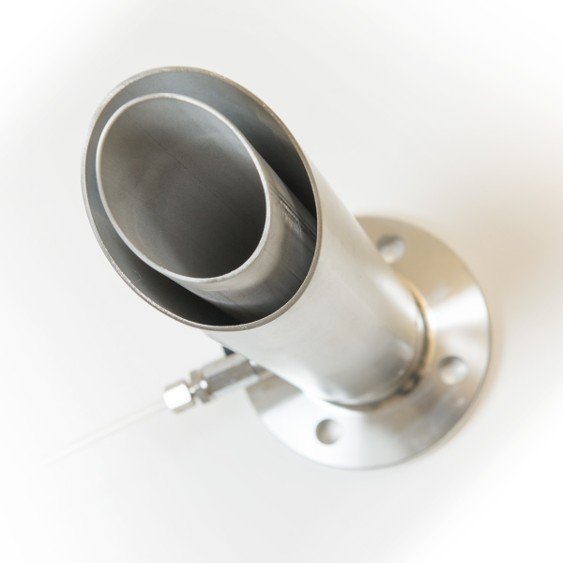
Photo: TUBEForce
Smart Layout to Avoid Extra Double-Wall Pipes
Double-wall pipes are required throughout all safety zones where methanol is transported.
This design choice carries real technical, financial and operational consequences:
- Double-wall pipes cost more, often significantly more per metre than single-wall pipe of equivalent bore.
- They need auxiliary systems; nitrogen supply or mechanical ventilation for the annular space, which means extra pipe branches to route, support and maintain.
- They have to be monitored continuously, so signal cables and sensors run alongside them the entire length.
- They bring their own structural headaches. Vibration and fatigue need proper assessment: cyclic loads from high-pressure fuel injection pumps can drive severe high-frequency, low-amplitude vibration, and the standard pipe support rules that work fine for other lines aren’t enough here. Hangers and supports need a dedicated study, ideally backed by a flow-induced vibration and natural frequency check rather than a generic spacing table.
Given all this, it’s clear that double-wall pipes, especially on high-pressure lines, should be avoided wherever the layout allows it.
The design philosophy that gets you there rests on two factors:
- The FTR should sit as close as possible to the consumers
- The FTR should be adjacent to a methanol fuel tank
This layout strategy isn’t always achievable on a real GA, but it remains the most effective lever for cutting costly double-wall piping and de-risking the project overall.
The Engineering Edge
Designing a Methanol Fuel Treatment Room isn’t just about referencing the Interim Guidelines or running a general arrangement study in CAD.
Real expertise is in anticipating how bulky components, airlocks above all, and sensitive elements like double-walled piping fit together on a hull-structure that was rarely drawn with methanol in mind from day one.
Get this wrong, or skip a proper early assessment, and the consequences aren’t limited to the FTR itself: a badly positioned fuel preparation room tends to ripple through the entire ship layout, forcing late-stage rework that’s expensive to fix and even more expensive to delay.
We’ve seen projects lose months to exactly this, an FTR placed without a right piping assessment and discovered only once basic engineering was already underway.
At Flowazur Consulting, in our feasibility study service we work with low-flashpoint fuels, and we support the piping engineering activities as well.
Our piping layout engineers have several years of onboard experience, with a practical knowledge of the vessel and its less visible constraints.
Book a call with our engineers to discuss your project.
Frequently Asked Questions
Q: Is methanol covered directly by the IGF Code?
A: No. it’s regulated through the IMO’s Interim Guidelines (MSC.1/Circ.1621).
Q: What hazardous area classification applies to a methanol FTR?
A: Zone 1, which requires independent, negative-pressure mechanical ventilation at a minimum of 30 air changes per hour.
Q: When does the FTR need A-60 fire boundaries?
A: Whenever it shares a bulkhead with a Category A machinery space.
Q: What’s the minimum airlock size for FTR access?
A: 1.5 m² of deck area
Q: Why are double-walled pipes required outside the FTR?
A: Methanol fuel piping running through enclosed spaces needs a secondary barrier.